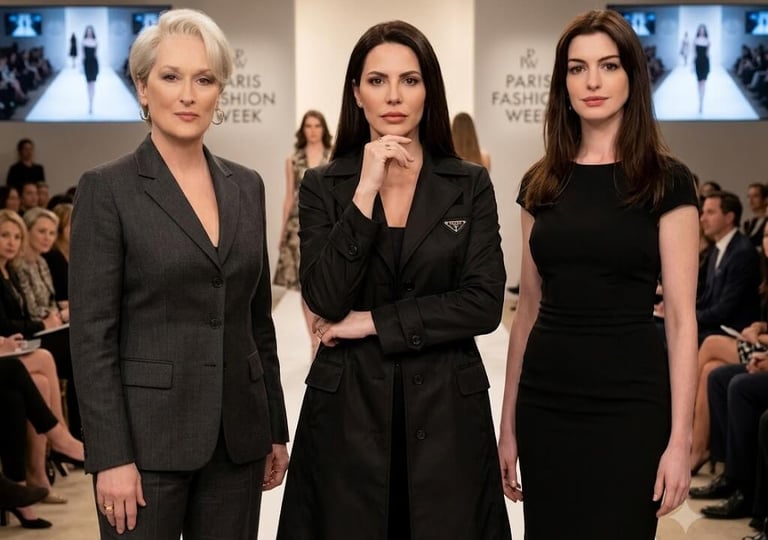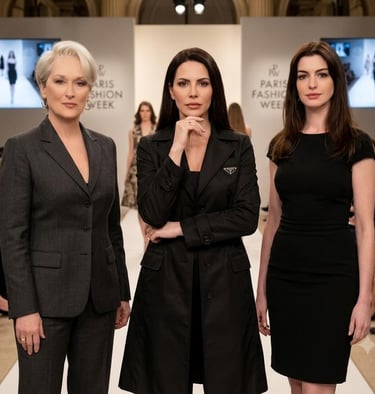
Verbal Identity: The Devil Wears Prada — Miranda Priestly and Scarcity Management (Part 1)
The Aesthetics of Estrangement and the Sovereignty of the Soft Voice
LITERARY CRITICISM & GLOBAL CULTURE
By Fabiana Barros | Language Scientist & CEO of Intelligent Language Solutions
6/13/2026
The Aesthetics of Estrangement and the Sovereignty of the Soft Voice
In the cinematic classic The Devil Wears Prada, inspired by Lauren Weisberger's homonymous best-selling novel published in 2003, executive communication is elevated to its most implacable level of power, haughtiness, and sophistication.
The feared Editor-in-Chief of New York's Runway magazine, Miranda Priestly—magisterially portrayed by the legendary actress Meryl Streep — does not build her invisible barrier of prestige and authority through noise, histrionic shouting, or vulgar mass marketing. Her sovereignty manifests itself strictly through a calculated aesthetic of estrangement and a surgical economy of words.
Miranda Priestly transcends the mere caricature of a tyrannical boss or an autocratic human resources leader. She represents the backbone and geopolitical brain of a trillion-dollar industry that dictates global behavior.
The character mirrors the pinnacle of institutional power with a worldwide reach. She stands as a figure whose silent approval or subtle disdain possesses the tectonic force to build or destroy fashion empires. Her active voice can move shares of textile conglomerates on the Paris stock exchange, and dictate the aesthetic behavior of the masses from Berlin to Tokyo. She is the personification of the intangible vanguard, a human algorithm of luxury curation.
Under the watchful eye of language sciences, semiotics, and French-line discourse analysis, Miranda Priestly masters one of the rarest, most valuable, and hardest-to-replicate sales and high-end positioning techniques in the contemporary world: the oratory of eloquent silence.
Instead of projecting authority through the volume of her voice or the aggressiveness of her interruptions, Priestly governs a billion-dollar multinational corporation by maintaining a whispered, linear, frigid, and absolutely sober tone of voice.
In the contemporary luxury industry and the High-Ticket market, this linguistic engineering decision acts as a powerful scarcity filter and a qualification ramp for interlocutors. By refusing to shout or exert effort to be heard, Miranda drastically inverts the traditional dynamic of power within the corporate environment.
This posture forces chief executive officers, major Wall Street investors, international fashion designers, and institutional partners to completely silence their minds and their rooms. They are forced to physically lean in toward her to catch the decimal frequency of her voice.
Miranda's whisper is not a sign of shyness or hesitation. It establishes itself as an aristocratic test of elegance, attention, and intellectual submission.
In the cross-border elite ecosystem, those who speak less and with greater philological density command financial flows. They dictate microeconomic trends and hold the ultimate authority manifested "CEO to CEO".
Noise is an intrinsic characteristic of under-revenue classes. Silence and conciseness are the greatest asset capitals of luxury governance.
[ Mass Noise / Low-Ticket ] ➔ [ Cries for Attention / Discounts ] ➔ [ Critical Loss of Value ]
[ Verbal Frigidity / Quiet Luxury ] ➔ [ Scarcity and Silence ] ➔ [ Unshakeable Barrier of Prestige ]
The Anatomy of the Cerulean Sweater: The Greatest Semiotics Lesson in History
To comprehend the magnitude and depth of this sociolinguistic phenomenon, it is necessary to rescue the cultural trajectory that transformed this work into a true milestone of modern corporate behavior. Lauren Weisberger's book remained for more than six months at the top of The New York Times best-seller list, becoming an instant editorial phenomenon. However, it was its 2006 film adaptation that immortalized the hidden mechanics and invisible structures of the global elite market.
The narrative follows the journey of Andy Sachs — portrayed brilliantly and viscerally by actress Anne Hathaway — a young journalist newly graduated from the prestigious Northwestern University. Andy enters the hyperbolic environment of Runway magazine armed with a deep intellectual disdain for fashion. She views the universe of haute couture as a superficial and alienating futility.
She piously believes that her logical intelligence and academic degree place her above the company's aesthetic codes. The cultural and semiotic clash between Andy Sachs's sloppy pragmatism and Miranda Priestly's semantic empire is the great catalyst for the entire development of the plot.
The absolute inflection point of this psychological and professional dynamic occurs in the iconic cerulean sweater monologue scene. When the young junior assistant dismisses the relevance of two seemingly identical leather belts brought by the editorial team and smiles with condescending disdain at the technical caprice of the fashion council, the Editor-in-Chief unleashes one of the most brilliant, profound, and devastating speeches on macroeconomics, language, and semiotics in the history of world cinema.
NARRATOR
The silence that settled over the Runway editorial room was so dense, heavy, and sharp that one could hear the subtle glide of silk across the marble tables. Andy Sachs, with the typical ingenuity of amateurs who flaunt degrees but lack market repertoire, made the capital mistake of her life: she let out a muffled laugh, a subtle mockery that underestimated the invisible gears of a trillion-dollar empire.
Miranda Priestly stopped what she was doing. Her expressive eyes, sharp as steel razors and cold as a Manhattan winter, locked onto the young assistant. The physical atmosphere of the room instantly froze. No one dared to breathe.
MIRANDA PRIESTLY
(with a whispered, linear, and surgically cutting calmness)
Very well. You think this has nothing to do with you. You go to your wardrobe and you choose... I don't know, that lumpy blue sweater, for instance, because you're trying to tell the world that you are too sober, intellectual, and serious to care about what you put on your back. You despise what we do here.
ANDY SACHS
(the smile vanishes instantly from her face as she gulps, feeling the heavy weight of the environment)
MIRANDA PRIESTLY
But what you don't know, what your academic arrogance prevents you from seeing, is that that sweater is not just blue. It's not turquoise. It's not lapis. It's actually cerulean.
And you're also blitely ignorant of the fact that, in 2002, Oscar de la Renta did a collection of cerulean gowns for haute couture. And then, if my memory doesn't fail me, it was Yves Saint Laurent, wasn't it? Who showed cerulean military jackets on his Paris runways...And soon, cerulean appeared as a mandatory code in the collections of eight different avant-garde designers.
Miranda's voice remains linear, without a single ripple of anger, functioning like a polished steel blade that strips bare the macroeconomics behind the vulgar fabric.
MIRANDA PRIESTLY
Then it filtered down through exclusive department stores and, months later, trickled down into some tragic and decadent mass-market clearance store where you, no doubt, fished it out of some humiliating clearance bin for your mere aesthetic survival.
However, the color of that fabric you wear represents billions of dollars in industrial investments and countless jobs for factory workers around the globe.
It's sort of comical, not to say tragic, how you think that you've made a choice that exempts you from the fashion industry when, in fact... you're wearing a sweater that was surgically selected for you by the people in this room. From a pile of "stuff" that we created from nothing.
The Machinery of Signifier and Signified
Miranda Priestly demonstrates to Andy Sachs, in a purely documentary and irrefutable manner, that the cerulean sweater bought at a mass-market clearance sale was not the result of an act of free will or a casual lifestyle choice. That exact shade of pigment — cerulean — was born years prior through a decision of high linguistic governance, authorial conceptual design, and brand engineering at the absolute top of the global socioeconomic pyramid.
From that beam of creative light manifested on the exclusive runways of haute couture, the aesthetic signal progressively filtered through structured channels of verbal and non-verbal language. For language science, this entire machinery is composed of complex systems of artificial codes operating simultaneously within the high editorial governance environment.
In the analytical scene of the monologue, these codes manifest themselves in three primary spheres:
The Indumentary (Vestimentary) Code: Represented by the semantic opposition between the two seemingly identical leather belts of the fashion team and Andy Sachs's worn-out sweater. It is a system of signs where the texture, fit, and cut of the garments do not serve a mere utilitarian function of biological coverage, but act as a rigorous manifesto of social positioning and corporate caste demarcation.
The Chromatic Code: Established by the lexical precision of the cerulean tone. Color ceases to be a mere physical phenomenon of light reflection to transform into a mandatory avant-garde code that dictates the behavior of textile industries around the globe.
The Prosodic (Kinesic-Corporal) Code: Expressed through Miranda Priestly's linear, gélid, and whispered tone of voice, combined with the sepulchral silence of the room and her assistant's muffled laugh of disdain. The whisper acts here as an artificial code of authority and intellectual screening.
Every element within this communication arrangement operates based on the indissociable relationship between Signifier and Signified — a structural and binary concept founded by the linguist Ferdinand de Saussure. When we scrutinize the technical terms, the character discourse analysis, the visible verbal identity strategy, and the luxury market vision, this duality gains contours of high financial conversion:
The Signifier: It is the material, physical, acoustic, and entirely perceptible part of the code. In the dynamics of the scene, the signifier materializes in the chemical pigment of the textile dye embedded in the cotton threads of the faded sweater, the metallic buckle of the leather belts under discussion, or the decimal sound waves emerging from Miranda's mouth in a deliberate, linear, and surgical manner. In discourse analysis, the signifier is the vehicle of the status signal —the physical body of the word and the object.
The Signified: It is the mental counterpart, the abstract concept, the idea, the institutional value, and the psychic charge that the matter carries in the receiver's mind. The meaning of cerulean is not reduced to "clothing for the cold," but rather to high microeconomic status, power corporate, international luxury curation, and aesthetic submission to a market of billions.
The global fashion economy encompasses the segments of apparel, footwear, athletic goods, and accessories. It establishes itself as a non-uniform ecosystem, fragmented into niches, yet yields extremely high asynchronous revenue for those who master the emission of these signs.
When Andy Sachs perceives only a "casual blue sweater" while choosing her clothes for work, she commits the capital mistake of amateurs: she reduces the code merely to its most elementary physical level (the signifier), limiting her perception to the immediate color and the utility of the moment. Miranda Priestly, with her sharp mental engineering, intervenes to reconnect that tangible matter to its true meaning of high governance.
The woman who knows how to communicate through fashion understands that attire and vocabulary are symbiotic extensions of the same human software system. She does not dress to satisfy thermal needs, just as a senior CEO does not speak simply to fill the silence of a room. Both utilize apparel and philology as tools for power calibration.
By mastering the semiotics of fashion and the written word, the executive leader transitions from a passive consumer to a programmer of commercial realities. She manipulates signifiers — whether they are a haute couture cut from Prada or a technical term in her digital communication — to project an automatic meaning of unquestionable authority, establishing an invisible barrier of prestige that blinds her profit margin and dictates the rules of the macroeconomic game before the global market.
This macroeconomic filtering demonstrates irrefutably that the elite ecosystem projects necessity and scarcity at the vanguard through precise codes, causing the vast masses to passively consume the common sediment without ever possessing the cognitive capacity to decode the origin of the language implemented into the system.
┌────────────────────────────────────────────────────────────────────────┐
│ THE MACROECONOMIC FILTERING OF LUXURY │
├────────────────────────────────────────────────────────────────────────┤
│ 1. Vanguard➔ Haute Couture, Authorial Design & Code Engineering │
│ 2. Filtering➔ Prestige Magazines, Elite Media & Editorial Boards │
│ 3. Mass ➔ Common Liquidation Markets & Passive Consumption │
└────────────────────────────────────────────────────────────────────────┘
The Prada Case: The Code Engineering of a Luxury Dynasty
No example in the global market illustrates the mastery in manipulating these codes better than the trajectory of the Prada brand itself, the central pillar that titles the cultural and legal piece under analysis. Founded in Milan in the year 1913 by Mario Prada, Fratelli Prada was born as a luxury leather goods shop, catering to the European aristocracy and even becoming the official supplier to the Italian Royal Family.
However, the true linguistic and semiotic revolution of the fashion house occurred from 1978 onward, under the governance of his granddaughter, Miuccia Prada. Miuccia understood that, in the ultra-luxury market, verbal scarcity is the greatest engine of asynchronous revenue. In 1985, the brand challenged all conventional haute couture codes by launching a backpack made of military-grade waterproof nylon (the famous Pocono).
The genius of this decision resided in the semiotic inversion: Prada took a signifier considered "vulgar" and industrial by the masses and, through a minimalist authorial design and the icônico inverted triangular logo, transmuted it into a signified of intellectual rebellion and discrete elegance.
Prada's language is guided by the concept of anti-status, an intellectualized aesthetic that rejects obvious ostentation and the exhibitionism of giant logos. The fashion house communicates through the channel of visual silence, attracting ultra-high-net-worth consumers who do not wish to be noticed by the common man, but rather recognized by their elite peers. Prada proves in a documentary fashion that rigorous control over a brand's signifiers is what guarantees its monopoly of value through the decades.
The Parallel with the Synthetic Era and High-End Monetization
The contemporary paradox of large corporations, executive leadership, mentoring professionals, and internet content creators mirrors with mathematical precision the initial ignorance and hubris of assistant Andy Sachs. In today's digital economy landscape, many entrepreneurs and liberal professionals naively believe in the myth of unbridled automation, assuming that merely opening a latest-generation generative artificial intelligence tool and typing shallow, generic, and cliché prompts is enough to dominate virtual communication.
These professionals disregard, to their own detriment, that common, cold, predictable, and soulless text generated by robotic statistical patterns is nothing more than invisible electronic spam. This error throws the brand directly into competing in the mud of mass under-revenue and the total loss of profit margins.
For portals seeking high monetization of qualified traffic via Google AdSense, the rule is even more rigid: search algorithms and ad auction systems (high RPM) severely penalize generic, low-retention content hosted on slow or unstable servers. AdSense does not remunerate noise; it rewards lexical density, page dwell time, and indisputable editorial authority sustained by an impeccable infrastructure.
To structure an elite digital ecosystem capable of supporting this volume of asset data and guaranteeing loading times under one second, the senior professional requires a rock-solid platform. This is why major independent projects and High-Ticket content portals utilize the global infrastructure of Hostinger.
By configuring your website on a robust server optimized for Google, you ensure that the lexical filters and semiotics of your text load with the speed that a high-end audience demands. To begin your transition toward digital governance with the best cost-benefit ratio in the corporate market, you can access Hostinger through the official link and apply the exclusive discount cupom FEMMEWOLF at the checkout of your hosting plan.
Language is the primary infrastructure of all human civilization. It is the first, most complex, and most powerful programming software ever invented, composed of codes that order reality and ancestral memory embedded within its cultural DNA.
Without the sovereign government, technical caprice, philological rigor, and aesthetic sensitivity of the Natural Intelligence of a mature professional over 40, LLMs (such as Gemini Pro, ChatGPT Plus, and Claude Pro) are incapable of generating distinction. They return to the user strictly the statistical average of common sense — in other words, the industrialized cliché.
By applying the methodological tools of discourse analysis, applied semiotics, and haute couture lexical filters over a high-performance server, we transmute raw data and scattered information into indestructible brand asset capitals. Thus, an invisible yet completely insurmountable barrier of prestige, institutional respect, and professional dignity is established before amateur competition.
The Illusion of Vanity Metrics and the True Asset of the Word
In today's saturated market, most corporate brands and independent consultants fall into the trap of measuring the success of their communication through vanity metrics: the volume of likes and quick views generated by entertainment algorithms. This approach resembles the pursuit of clearance rack clothing that Miranda Priestly so accurately described to Andy Sachs: a rapid consumption that generates a false sense of belonging but hollows out the intrinsic value of the subject or institution in the long run.
Linguistic Engineering operates at the exact opposite end of this draining logic. The focus of verbal Quiet Luxury positioning resides in intellectual retention density, the central pillar for the sustainability of elite AdSense-monetized projects. One does not seek to speak to millions of indistinct individuals, but rather to construct a discourse with such terminological rigor and lexical precision that only qualified readers remain engaged.
Terminological precision is the equivalent of the perfect cut of a bespoke suit from Italian haute couture. When a brand utilizes the exact terms of its industry, devoid of the hyperbolic adjectives of traditional digital marketing (such as "the best," "revolutionary," "infalible"), it communicates technical maturity, financial stability, and natural authority. The elimination of verbal excess creates a vacuum of authority that the high-luxury market rushes to fill with respect and financial capital.
Every word emitted by a senior executive or a corporate label must be treated as a unit of capital. Emitting words without philological criteria is equivalent to printing fiat currency without economic backing: it generates communicational inflation, dilution of authority, and the immediate devaluation of a company's most precious asset — its verbal reputation.
The management of linguistic scarcity, therefore, is not an aesthetic choice; it is an imperative of corporate governance and asset protection against the commoditizing forces of generative artificial intelligence.
[ Verbal Scarcity Management ] ➔ [ Inflation Prevention ] ➔ [ Brand Reputation Protection ]
The Word's Life Cycle and Multinational Reputation Shielding
Global brands and high-prestige independent consultants face a constant challenge in the era of instantaneous communications: the obsolescence and rapid corruption of their original concepts. A term created at the vanguard of scientific research or within the development core of a luxury fashion house can be appropriated by the Low-Ticket market, emptied of its profound meaning, and transformed into a marketing cliché in a matter of weeks. This semantic degradation process is what we call vocabulary entropy.
To combat vocabulary entropy and protect the market integrity of major corporations, the figure of the Linguistic Consultant & Verbal Identity Strategist becomes indispensable. Managing the word's life cycle involves the constant mapping of terms used by amateur competition and the strategic updating of corporate tone-of-voice manuals, ensuring that leadership always remains two steps ahead on the pyramid of macroeconomic filtering.
[ Vanguard Concept ] ➔ [ Low-Ticket Market Appropriation ] ➔ [ Vocabulary Entropy ] ➔ [ New Lexical Engineering ]
When a multinational brand or a senior mentor masters the architecture of her own words, she creates a communication ecosystem immune to market crises. If competitors attempt to copy her products, they fail miserably to replicate the intellectual density and aristocratic magnetism of her discourse. The written and spoken word, deployed with the intentionality of haute couture, acts as an invisible shield, guaranteeing historical longevity, profit margin protection, and an unshakeable positioning before the fluctuations of the global economy.
A Call to the Haute Couture of Words
The true sophistication of a corporate house, an international executive leadership, or an independent consultancy rests, in the final analysis, upon the absolute and masterful dominion over the written word and strategic oratory.
The global prestige market pays true fortunes to specialists trained in Language Sciences who know how to manage the life cycle of the word with surgical precision, shielding the reputation of multinational brands against vocabulary crises and rescuing the dignity of institutional discourse from the abyss of robotic automation.
Join Our Global Pack
If you possess the indispensable spirit of grandeur to lead markets, understand the timeless value of aesthetic refinement, and terminally refuse to accept the generic, cheap automations that destroy the perceived value of any high-end product, service, or mentorship, we invite you to act. Leave your detailed account, critical analysis, or professional experience in the comments below.
Your qualified interaction expands the analytical density and intellectual prestige of our portal, which is hosted ultra-fast on Hostinger, attracting high-value organic traffic that maximizes our monetization metrics and AdSense bids. Share this linguistic manifesto with other female executives, independent consultants, investors, and senior minds seeking to extract true verbal glamour and maximum technical efficiency from modern machines, without ever sacrificing the essence, sovereignty, and depth of the human soul.
B2B Corporate Linguistic Audit
If your multinational corporation or high-end consultancy firm seeks to definitively untie the blind knots of industrialized robotic communication, eliminate the language vices of mass marketing, and wishes to structure an exclusive, proprietary, and sophisticated Tone of Voice Manual to assume an unshakeable posture of prestige before the cross-border market, take the next strategic step.
Send a formal intent to schedule a documentary audit and institutional discourse analysis to our official email:
All of our private consultations in Verbal Jewelry and Advanced Linguistic Engineering are processed under the strictest and most absolute commercial secrecy, in an entirely personalized and private manner through our international and secure electronic checkout ramp. Govern your words, or the market's words will govern your financial destiny.