
Verbal Aesthetics in Technology: How Apple and Tesla Use Linguistic Minimalism to Justify Price Premiums in the B2B Market
Language as Value Architecture
VERBAL IDENTITY & LUXURY BRANDS
By Fabiana Barros | Language Scientist & CEO for Digital Language Solutions
7/24/2026
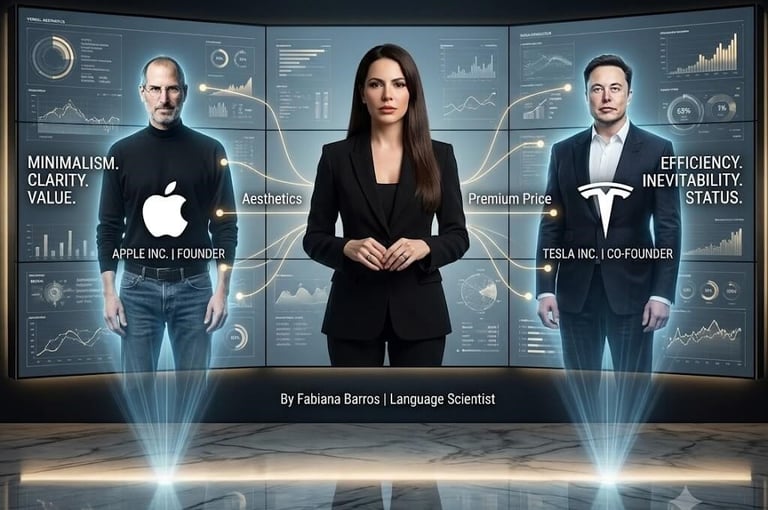
In the B2B (Business-to-Business) universe, pricing is traditionally dictated by cold metrics: Return on Investment (ROI), Total Cost of Ownership (TCO), technical specifications, Service Level Agreements (SLAs), and comparative feature spreadsheets. However, in a global ecosystem saturated with technological commodities — where hardware and software parity are achieved in increasingly shorter cycles —pure specifications are no longer the sole engine driving high profit margins.
An often underestimated yet structurally decisive element emerges: verbal aesthetics.
Verbal aesthetics in technology is not merely about "writing well" or crafting memorable advertising slogans. It is the engineering of language — the intentional, calculated, and systematic use of text, lexical choice, syntax, and information architecture to construct an inseparable perception of value, elegance, and authority. When applied with rigor, language ceases to be a mere descriptive vehicle and acts as a cognitive filter that alters the perceived value of a product or service.
Companies like Apple and Tesla have mastered this art in the consumer market (B2C), but what few analysts observe is how this exact premise was adapted and scaled for the corporate environment (B2B). Both corporations utilize linguistic minimalism to disarm the resistance of institutional buyers, bypass price wars, and justify price premiums that challenge the conventional logic of corporate procurement and bidding processes.
This article analyzes the linguistic, psychological, and market mechanisms behind Apple's and Tesla's verbal minimalism, demonstrating how vocabulary restraint and radical clarity have become the most profitable intangible assets of modern technology.
1. The Concept of Linguistic Minimalism in the Technological Context
To understand the impact of verbal aesthetics on B2B pricing, it is first necessary to conceptualize linguistic minimalism through the lenses of applied linguistics and cognitive psychology.
Linguistic minimalism is not the absence of information, but rather maximum semantic density with minimum syntactic noise. It is the application of Occam's Razor to corporate text: the removal of all unnecessary jargon, empty qualifiers ("the best," "market leader," "revolutionary"), and passive constructions that distance the subject from the action.
1.1 Cognitive Load and the Law of Least Effort
Cognitive psychology teaches us that the human brain — even that of a Chief Technology Officer (CTO) or head of procurement—constantly seeks to conserve energy. This phenomenon is guided by processing fluency: the ease with which the brain processes information.
· Dense and Jargon-Heavy Text: Requires high cognitive effort. The buyer must "translate" acronyms, interpret obscure clauses, and filter out sales hyperbole. This effort generates friction and subconscious suspicion.
· Minimalist and Fluid Text: Is processed rapidly. Ease of processing is psychically associated with truth, trust, and superiority.
When a B2B company communicates a complex solution through crystal-clear, direct language, it implicitly conveys a message of absolute mastery: "We are so advanced that we do not need to hide behind complex technical vocabulary to impress you."
1.2 The Reduction of Perceived Complexity
In B2B, technology purchases involve risk. Decision-makers fear integration failures, hidden costs, and steep learning curves for their teams. Linguistic minimalism directly addresses this pain point:
Traditional B2B Communication
Minimalist Communication (Apple/Tesla Aesthetic)
"Integrated encrypted hardware ecosystem solution for centralized mobile device fleet management."
"Your company’s fleet. Secure. Under control."
"Implementation of sustainable energy infrastructure with high-efficiency photovoltaic modules and stationary storage."
"Uninterrupted power for your operation. From the sun to your factory."
The first column sells complexity (and with it, fear of failure and the need for expensive support). The second column sells pure end results. It is this simplification of discourse that authorizes charging a premium price, as the buyer perceives they are purchasing the definitive resolution to a problem, rather than a tangle of technical components.
2. Apple in B2B: Transforming Corporate Hardware into a Status Experience
Historically viewed as a consumer-focused brand, Apple has quietly built a multi-billion-dollar B2B operation. From the financial sector to Silicon Valley tech giants, the Apple ecosystem (Mac, iPhone, iPad, Apple At Work) has become the gold standard for companies seeking to attract and retain top talent.
However, in terms of pure hardware specifications (RAM, storage, display refresh rate), Apple devices often cost between 30% and 70% more than equivalent competitors running Windows or Android. How does Apple justify this price differential to cost-focused IT departments?
The answer lies in its institutional verbal aesthetics.
[ Hardware Complexity ] ──(Apple Minimalism Filter)──> [ Promise of Human Productivity ]
2.1 The Grammar of "It Just Works"
Apple does not sell computers to enterprises by listing clock frequencies in GHz or bus architectures on the main landing pages of its corporate solutions. Apple’s B2B language is focused on the human subject performing the work, using present-tense indicative verbs and short declarative sentences.
Examples of Apple's B2B verbal aesthetic:
· "Power for your business."
· "Easy to deploy. Simple to manage."
· "Security built in from the ground up."
Notice the use of firm, decisive punctuation. The use of periods in nominal phrases or incomplete sentences creates a tone of unquestionable assertion. There is no room for doubt or relativization.
2.2 Disarming IT Departments with Euphemisms of Efficiency
The major hurdle for Apple in B2B has always been resistance from IT departments accustomed to complex control panels. Apple overcame this barrier by redefining IT management through language.
Instead of listing complex security protocols like AES-256, Zero-Trust Architecture, or MDM Enrollment Profiles, Apple uses terms such as:
· "Zero-touch deployment": Three words that encapsulate hours of IT labor and instantly communicate operational cost savings.
· "Privacy by design": Transforms a tedious regulatory requirement (GDPR/LGPD) into an intrinsic aesthetic and ethical attribute of the product.
·
By leveraging words with high emotional resonance and low technical density, Apple makes the CTO feel that paying more for a Mac is not an extra hardware expense, but an investment in eliminating support tickets. Minimalist language redefines the value equation: the product price is high, but the cost of friction is zero.
3. Tesla B2B: The Discourse of Vanguard and Physical Efficiency
While Apple applies linguistic minimalism to office environments and digital productivity, Tesla extended this same philosophy to heavy industry, the energy sector, and corporate fleets.
Tesla’s B2B division — encompassing the Tesla Semi (electric trucks), Megapack (utility-scale energy storage), Commercial Solar, and Model 3/Y fleets — operates in a market traditionally dominated by dry engineering data, torque charts, and emissions reports.
Tesla revolutionized this segment by importing the verbal aesthetic of minimalism into the industrial B2B sector.
3.1 Absolute Reduction: The Product Name as Function
While traditional commercial truck manufacturers name their vehicles with dry alphanumeric combinations (e.g., FH16-750 Heavy Duty GlobeTrotter), Tesla named its corporate lineup with direct, literal terms:
· Tesla Semi: A reduction of the term "semi-truck" to its fundamental essence.
· Megapack: The fusion of a magnitude prefix with the simplest word for packaging.
· Powerwall / Powerpack: Literal descriptions of what the object is and does.
This nomenclature is not accidental. It signals to corporate buyers that the internal design complexity has been solved to such a degree that the final product is purely its function.
3.2 Statistical Minimalism: Only the Metrics That Matter
Tesla's linguistic minimalism is also reflected in how it presents technical B2B data. Rather than offering 100-page manuals at the initial sales contact, Tesla condenses its B2B value proposition into three or four inescapable aesthetic metrics.
For the Tesla Semi, aimed at logistics and supply chain directors:
"Less than 2 kWh per mile. Acceleration 0 to 60 mph in 20 seconds fully loaded. Estimated fuel savings up to $200,000 within the first three years."
The syntax is devoid of intensifying adverbs. There is no use of words like "incredible," "amazing," or "revolutionary." Tesla allows the contrast between cold numbers and short sentences to generate dramatic impact.
[ Pure Technical Data ] + [ Short Declarative Sentence ] = [ Perception of Technological Inevitability ]
By adopting this aesthetic, Tesla justifies a starting purchase price substantially higher than that of an equivalent diesel truck. Minimalist language projects an aura of technological inevitability: choosing any other option suddenly feels like an outdated and administratively irresponsible decision.
4. Anatomy of the High-Value Sentence: Syntactic Structures of Apple and Tesla
To apply verbal aesthetics in B2B, one must examine the syntactic and rhetorical patterns Apple and Tesla use to transform words into profit margins. Linguistic analysis of both brands' B2B communications reveals three structural pillars:
┌─────────────────────────────────────────┐
PILLARS OF B2B MINIMALISM │
└────────────────────┬────────────────────┘
│
┌─────────────────────────────┼─────────────────────────────┐
▼ ▼ ▼
┌───────────────────┐ ┌───────────────────┐ ┌───────────────────┐
│ 1. Parataxis and │ │ 2. Absolute │ │ 3. Elimination of │
│ Asyndeton │ │ Nominalization │ │ Adjectives │
└───────────────────┘ └───────────────────┘ └───────────────────┘
4.1 Parataxis and Asyndeton
Parataxis is the juxtaposition of clauses without subordinating conjunctions. Asyndeton is the intentional omission of coordinating conjunctions (such as "and," "but," "therefore").
· Common B2B Syntax: "Our servers feature triple redundancy so that your company experiences no unexpected downtime and can maintain continuous productivity."
· High-Value Minimalist Syntax: "Zero downtime. Zero losses. Continuous productivity."
The absence of conjunctions gives the text a hammer-like cadence. Each phrase emerges as an accomplished fact, an axiomatic truth. In a B2B context, this communicates extreme operational security.
4.2 Absolute Nominalization
Nouns convey stability and permanence; verbs in the future or conditional tense convey uncertainty. Both companies favor strong nouns over hypothetical verb constructions.
Instead of writing:
"If your company decides to adopt our industrial battery services, you may notice a drastic reduction in peak energy tariffs."
Tesla’s communication reduces the sentence to:
"Peak-shaving savings. Grid autonomy. Sustainability at scale."
The nouns "Savings," "Autonomy," and "Sustainability" function as conceptual pillars. They do not promise a possibility; they present a state of reality.
4.3 Elimination of "Salesy" Adjectives
One of the greatest paradoxes of linguistic minimalism is that the less you try to sell through adjectives, the more you sell. Adjectives like efficient, excellent, innovative, robust, and industry-leading have become white noise in B2B. They signal weakness: the need to convince the buyer of qualities the product should demonstrate on its own.
Apple and Tesla purge their B2B copy of these qualifiers. When they do use adjectives, they opt for adjectives of measurable or indisputable physical state: stainless, silent, integrated, autonomous.
5. How Linguistic Minimalism Justifies the Price Premium in B2B
The core question of this article is: what is the exact mechanism connecting minimalist verbal aesthetics to the ability to charge corporate clients more?
Four socio-linguistic mechanisms drive this pricing power:
5.1 The Institutional Status Signaling Effect (Signaling Theory)
In B2B, procuring vendors is also a declaration of institutional identity. When a company purchases Apple equipment for its executive team or installs Tesla batteries in its facilities, it acquires the status associated with those brands.
Minimalist language is the aesthetic code of the tech elite. Luxury brands (like Hermès or Rolex) use brief, austere, and confident copy. Mass-market brands use verbose, discount-heavy, and loud copy. By adopting verbal minimalism in B2B, Apple and Tesla position their enterprise solutions in the functional luxury segment. B2B buyers accept paying the premium because part of that linguistic and visual prestige is transferred to the buying company's image before its own shareholders and clients.
5.2 Friction Reduction in Executive Approval
B2B commercial proposals often flounder at the C-Suite level (CEO, CFO, COO) because key information arrives diluted in lengthy technical reports. Linguistic minimalism creates portable sales arguments.
When a Chief Innovation Officer needs to justify purchasing Tesla or Apple solutions to the Board of Directors, they do not read from the technical manual; they repeat the brand's minimalist phrases:
· "We are adopting Mac because it reduces support costs by 40% and boosts talent retention."
· "We are installing Megapack to eliminate our vulnerability to peak energy rate spikes."
Short, polished, conceptual sentences travel through the corporate hierarchy without distortion. Minimalist copy equips internal champions with the exact ammunition needed to pass high budgets without friction.
5.3 The Principle of Inevitability and "Zero Risk"
Excessive jargon in B2B proposals often creates the impression that a solution is so complex that implementation will be painful and error-prone. Minimalist language conveys the opposite: that the problem has already been completely mastered and solved by the vendor's engineering.
Corporate buyers pay more to eliminate personal career risk. The classic corporate adage of the computing era — "Nobody ever got fired for buying IBM" — has been updated by Apple and Tesla's verbal aesthetics to: "Nobody gets questioned for choosing the most elegant and efficient solution on the market."
5.4 Breaking Away from Feature-by-Feature Comparison Tables
When a B2B company communicates products by listing long feature sets, it invites the buyer to conduct a head-to-head spreadsheet comparison (Feature x Feature). In a column-by-column comparison, the lowest-priced product usually wins.
Linguistic minimalism breaks this dynamic by refusing to play the detailed spec game upon first contact. Instead of competing over individual features, minimalist copy sells a unique category of solution.
· The competitor sells: "x Processor, y Gigabytes of RAM, cast aluminum chassis, 3-year on-site warranty."
· Apple sells: "The ultimate tool for modern work."
Because there is no direct textual parity with competitors, spreadsheet price comparison loses its validity. Apple and Tesla exit the commodity war and enter the realm of proprietary solutions tied directly to their aesthetic identity.
6. Practical Guide: Applying Minimalist Verbal Aesthetics to Your Company's B2B Language
Any enterprise technology firm, SaaS (Software as a Service) provider, industrial consultancy, or corporate service provider can extract lessons from Apple and Tesla to revamp its B2B communications and protect its profit margins.
Below is a four-step framework to transition from dense, bureaucratic communication to high-value verbal aesthetics.
[ STEP 1 ] Audit and Eliminate Jargon Noise
│
▼
[ STEP 2 ] Restructure Syntax into the Declarative Mode
│
▼
[ STEP 3 ] Build a "Proprietary Vocabulary"
│
▼
[ STEP 4 ] Condense the Value Proposition into a "Core Statement"
Step 1: Auditing and Eliminating Noise
Perform a complete audit of your company’s commercial proposals, corporate slide decks, websites, and sales collateral. Systematically eliminate:
1. Unproven Self-Praise: Remove words like excellent, leader, innovative, revolutionary, state-of-the-art, best-in-class.
2. Empty Corporate Buzzwords: Replace terms like synergy, holistic, paradigm, disruption with direct, descriptive language.
3. Passive Voice and Verbose Constructions: Change "A system was developed by our engineering team that allows..." to "We engineered the system to..." or simply "Our system delivers...".
Step 2: Restructuring Syntax
Adopt the one idea per sentence rule. Keep average sentence length to a maximum of 12 to 15 words.
· Before: "Our proprietary platform based on predictive artificial intelligence analyzes large volumes of operational data in real time to enable managers to make more assertive strategic decisions and reduce inventory waste." (31 words)
· After (Minimalist): "Real-time data analysis. Precise inventory forecasting. Zero operational waste." (10 words divided into three conceptual blocks).
Step 3: Building a Proprietary Vocabulary
Define 3 to 5 core anchor words that embody the essence of your solution, and repeat them consistently across all B2B touchpoints. Controlled repetition of an elegant vocabulary creates a sense of rigor and method.
Apple consistently uses: Integrated, Simple, Powerful, Secure.
Tesla consistently uses: Autonomous, Scale, Efficiency, Future.
What is the definitive lexical inventory for your solution?
Step 4: The Entry "Core Statement"
Every B2B commercial proposal should open with a high-impact minimalist statement before diving into contractual details or technical appendixes. This sentence should fit on a single line and convey the overarching value of the project to a C-Level executive.
· Example for a B2B Cybersecurity firm: "Your enterprise protected against digital threats before they happen."
· Example for a B2B Logistics firm: "Faster corporate deliveries. Lower cost per mile."
7. Challenges and Risks of Misapplying Minimalism
While minimalist verbal aesthetics are a potent pricing tool, incorrect application can cause severe side effects in B2B environments. Minimalism must never be confused with shallow content or the omission of critical data.
7.1 The Risk of Vagueness (Empty Minimalism)
If your company adopts short, conceptual phrases without the underlying technical capability to back them up, minimalism will be perceived as arrogance or a lack of substance.
· Rich Minimalism (Apple Style): "Security built in from the chip up." (Backed by real, documented hardware architecture available in technical whitepapers).
· Empty Minimalism: "The best security on the market." (Short phrase, but empty of meaning and lacking visible technical proof).
High-value minimalism works like the tip of an iceberg: the surface is clean and synthetic, but deep technical documentation must remain readily accessible should the client’s engineering team request an audit.
┌─────────────────────────────────────────┐
│ THE ICEBERG EFFECT │
└────────────────────┬────────────────────┘
│
Featured in Proposal │ [ Minimalist Aesthetic ]
(C-Level / Buyers) │ Short sentences, high impact
─────────────────────────┼─────────────────────────────
Featured in Appendix │ [ Technical Documentation ]
(Engineering / IT) │ Specifications and metrics
7.2 Tailoring Communication by Stakeholder Profile
In B2B, the buying journey involves multiple stakeholders. Verbal aesthetics must be calibrated based on who you are addressing within the client organization:
1. For the CEO / CFO / Board: Use absolute minimalism. Focus on business outcomes, status, security, and conceptual clarity.
2. For Engineers / IT Specialists: Provide complete technical documentation in clean, well-formatted appendixes, maintaining clear, precise prose without resorting to sales buzzwords.
The common mistake is sending dense technical jargon to the CEO, or relying solely on high-level conceptual slogans when presenting to the lead technical auditor.
Conclusion: Language as Profit Engineering
The history of technology shows that superior products do not always win in the enterprise market. Companies that secure dominant market positions and sustain high profit margins are those capable of translating technical sophistication into an experience of unquestionable clarity and authority.
Apple and Tesla have demonstrated that linguistic minimalism is neither a mere marketing gimmick nor a fleeting design trend. It is a deliberate strategy of value engineering. By stripping B2B communication of noise, jargon, and unnecessary fluff, these corporations:
· Elevate the perceived quality of their solutions;
· Reduce friction in executive decision-making;
· Bypass direct feature-by-feature price comparisons;
· Build an aura of industry leadership and inevitability.
In the landscape of digital business and enterprise tech — where complexity is the norm and information overload is constant — clarity has become the ultimate luxury item. Companies that master verbal aesthetics and the art of saying more with less will not only communicate better — they will gain the legitimate power to command higher prices for what they deliver. Language, in its purest and most disciplined form, is the definitive intangible asset of the information age.


