
The Publisher's Hard Tech Infrastructure: Hostinger Dedicated Servers and Data Security
The Material Backing of Silicon Valley: The Word Demands Hardware
TECHNOLOGY & ARTIFICIAL INTELLIGENCE
By Fabiana Barros | Language Scientist & CEO of Intelligent Language Solutions
6/14/2026
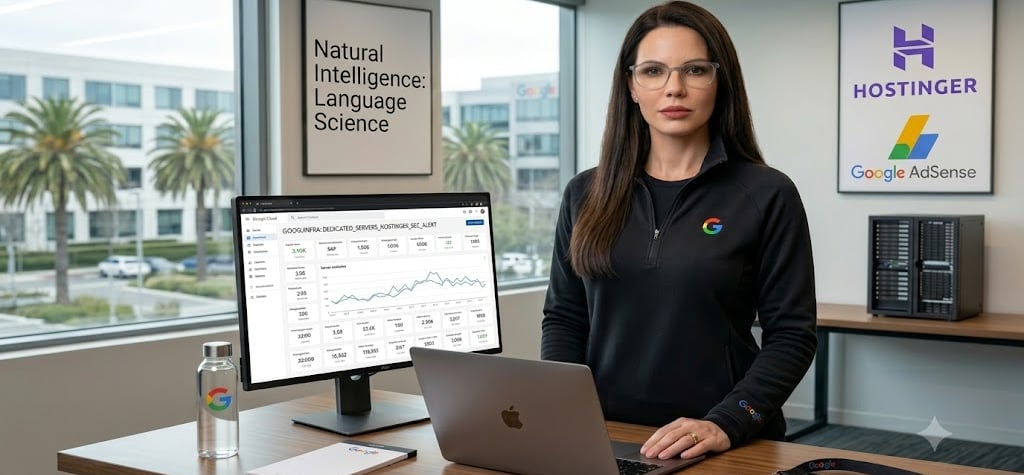
In the ecosystem of high corporate governance, many entrepreneurs make the strategic mistake of believing that the internet operates through an abstract, ethereal, and intangible cloud. The raw reality of Silicon Valley proves exactly the opposite: every line of code, every Large Language Model (LLM), and every structured SEO article requires a rigid, cold, and ultra-high-performance hardware backing. To generate billions in the global market and consolidate a brand's sovereignty, the word must be hosted on an indestructible infrastructure.
Tech giants in California, United States, understand that loading speed and data security are the central pillars of economic sovereignty, netting billions of dollars every year. If a senior corporation's website exhibits instability, packet loss, or takes longer than one second to render pixels on mobile screens, the decision-maker's brain immediately triggers cognitive fatigue.
The high-end user abandons the page, the perception of authority crumbles, and the institutional wealth of future investments and active digital revenue drains down the toilet in disappointment and loss of brand reputation—all because of this "minor server flaw."
Beneath the aesthetic layer of verbal glamour and interface design, there is a physical matrix of fiber optic cables, power substations, and server racks processing information at subatomic speeds. To ignore this structure is to sign a warrant of digital invisibility. For an executive leader's discourse to reverberate with power, it must travel through the fastest and most secure routes of contemporary network engineering.
[Shared / Slow Server] ➔ [Cognitive Fatigue] ➔ [Screen Abandonment & Revenue Drop]
[Dedicated Server / Hostinger] ➔ [Speed of Light] ➔ [Organic Retention & Commercial Scale]
The Rigor of Google's Laws: The Core Web Vitals Audit
To dominate the global passive traffic ecosystem, it is necessary to align your domain precisely with the technical auditing requirements of Google itself. Indexing bots (Googlebots) utilize rigid infrastructure metrics called Core Web Vitals to crawl, qualify, and define which sites deserve to occupy the absolute top of global searches. Google severely penalizes the noise, latency, and technological lag of low-tier, amateur servers.
It is at this market pattern interruption point that the senior Publisher migrates from digital amateurism to data robustness. Configuring your virtual property using Hostinger's Dedicated Servers and Cloud Computing technology is the definitive step to shield your corporate brand against algorithmic fluctuations.
By ensuring that your database and your bilingualized Voice and Tone Manuals load at the speed of light, you secure maximum scores in the indexing algorithms. The Hostinger site responds with military-grade stability, qualifying your page's ad placements to win Google AdSense's highest Cost Per Click (CPC) automated auctions and attract prestigious international advertisers.
┌────────────────────────────────────────────────────────┐
│ THE HARD TECH HOSTING TRIAGE │
├────────────────────────────────────────────────────────┤
│ 1. Dedicated Server ➔ Data Resource Isolation │
│ 2. SSL Encryption ➔ B2B Security Compliance │
│ 3. Maximum Speed ➔ Max Score in Core Web Vitals │
└────────────────────────────────────────────────────────┘
The Genesis of the Silicon Land: Where the Future Was Forged
To comprehend the magnitude of the modern digital empire, one must geolocate the epicenter of this revolution. Let us step back in time, to a place where verdant orchards gave way to silicon roads and data transmission antennas. Before the technological advent, the Silicon Valley region was purely agricultural, dependent on the natural cycles of the earth.
Cutting-edge research from the military sector during the World Wars changed this landscape forever, demanding more powerful radars and rapid communication systems. It was at this intersection of geopolitical data security needs and funded academic research that the North American ecosystem flourished.
Silicon Valley is not an official political-administrative boundary on the California map, but a geographic region spanning the northern portion of the Santa Clara Valley, extending up the San Francisco peninsula from San Jose to Palo Alto, passing through key cities like Mountain View, Cupertino, and Sunnyvale.
This region, now considered synonymous with intangible intellectual and financial wealth, has its roots deeply tied to the land and military hardware. Before becoming the home of microchips and artificial intelligence algorithms, the Santa Clara Valley was known as the "Valley of Heart's Delight", due to its vast and dense agricultural production of fruits, particularly prunes and apricots.
The Industrial Awakening and Terman's Legacy
The transformation of this bucolic landscape into a military industrial and technological hub occurred in the mid-20th century, driven by visionary minds who understood the need to decentralize technological development away from the East Coast of the United States. The great architect of this transition was Frederick Terman, then dean of the School of Engineering at Stanford University.
During the 1940s and 1950s, Terman noticed that young talent graduating in California systematically migrated eastward in search of employment in established industries. To stem this brain drain of young minds, he took two revolutionary measures:
* Stanford Industrial Park: He leased university-owned land to high-tech companies, creating an unprecedented symbiosis between academic research and private capital.
* Incentivizing Local Entrepreneurship: He directly stimulated his alumni to launch their own businesses in the region instead of seeking traditional corporate employment.
The term "Silicon Valley" was coined much later, in 1971, by journalist Don Hoefler in a series of articles for the weekly magazine Electronic News. The name celebrated the fundamental chemical element—silicon—used in the manufacturing of transistors and semiconductors that replaced old, slow thermionic valves, giving birth to modern computing.
The Cathedrals of Knowledge: Universities and Intellectual Infrastructure
The enduring success of Silicon Valley is not solely due to the availability of venture capital, but to the presence of an elite educational matrix that acts as a nuclear reactor of highly qualified human capital. Yes, they value Human Natural Intelligence alongside Artificial Intelligence. It is curious to note that many traditional companies operate in the opposite direction, devaluing human capital and forgetting that behind every intelligent automation lies an analytical brain polished in environments of high academic rigor.
Higher education and fundamental scientific research are the true global economic catalysts; without university laboratories, the financial market would have no disruptive products to fund. Three institutions stand out as the pillars of technical support in the region:
1. Stanford University
Located in Palo Alto, Stanford is the beating heart of the Valley. Founded in 1885 by Leland Stanford, the institution developed an academic culture aggressively geared toward patent commercialization and new business creation. Its computer science and artificial intelligence laboratories have shaped the foundations of the internet ever since.
The selection process to enter Stanford is one of the most competitive on earth, with an acceptance rate that frequently drops below 4%, requiring candidates to have not only flawless grades, but extraordinary leadership and real-impact projects. Great personalities and brilliant minds have walked its halls, such as Elon Musk (who started his PhD in applied physics at the institution before leaving to entrepreneur), as well as tech giant founders and global world leaders.
* Official Portal: [stanford.edu](https://www.stanford.edu)
2. University of California, Berkeley (UC Berkeley)
Situated on the eastern side of the San Francisco Bay, Berkeley brought scientific rigor, critical thinking, and an unshakeable tradition of innovation in engineering and open-source software (such as the BSD Unix ecosystem) to the matchless ecosystem. The university balances Stanford's pragmatism with a deep pursuit of theoretical excellence.
Its selection process is rigorous, evaluating social commitment combined with academic genius, attracting minds that challenge the technological status quo. Luminares such as Steve Wozniak (Apple co-founder) and Eric Schmidt (former Google CEO) passed through its facilities, consolidating the excellence of the region's most prestigious public institution.
* Official Portal: berkeley.edu
3. Santa Clara University (SCU)
As the oldest institution of higher learning in California, located at the geographic center of the Valley, Santa Clara University has trained generations of executives, operations leaders, and civil and software engineers who structured the corporate governance of the earliest major tech companies.
Unlike the purely technical profile of other institutions, SCU adopts a selective screening process focused on data ethics and high-lineage executive governance. Among its prominent alumni are individuals from corporate high governance, legal sector leaders, and chief technology officers of major tech multinationals.
* Official Portal: [scu.edu](https://www.scu.edu)
These universities created a continuous stream of talent that feeds back into the market with every innovation cycle. A Stanford student does not study just to get a job at a multinational; they are trained to found the next platform that will alter humanity's consumer behavior. Yes, we are talking about global high-value, high-impact tech fashion trends—the intelligence designer label behind Hardware and Software.
From Garages to Empires: The Evolution of Startups
Business literature frequently acts as a watershed moment in corporate leadership mindsets. The book “The Innovation Secrets of Steve Jobs” by Carmine Gallo precisely deconstructs the pillars of design, simplicity, and communication that turned Apple into a cultural empire. Reading this work allows one to understand that technological innovation does not reside solely in the raw code of machines and robots, but in the aesthetic appeal and brand narrative that make technology irresistible to the final consumer. A close reading of this classic reveals how refinement and clarity shape the consumer market.
Thus, startup culture was born in Silicon Valley and redefined how capitalism operates globally. The classic trajectory of a tech company starting in a residential garage and reaching a multi-billion-dollar market valuation has become the modern mythology of business success.
These agile ecosystems allowed brilliant creators to solve immediate global problems, transforming abstract ideas into high-value tangible assets—such as the development of open-source operating systems, unified commerce platforms, and predictive security software that protects the world's largest banks today.
The First Garage: Hewlett-Packard (HP)
In 1939, encouraged by Frederick Terman, engineers Bill Hewlett and David Packard began working in a small garage in Palo Alto with an initial capital of just 538 dollars. The duo's first commercially successful product was a high-precision audio oscillator, purchased by Walt Disney Studios to certify the sound system for the movie Fantasia. HP laid the groundwork for the Valley's organizational culture: horizontal hierarchies, respect for the engineer, and an relentless focus on impeccable technical quality.
The Betrayal That Created the Market: The "Traitorous Eight" and Fairchild Semiconductor
In 1956, William Shockley, co-inventor of the transistor and Nobel Prize winner, founded the Shockley Semiconductor Laboratory in Mountain View. However, his autocratic and paranoid management style became unsustainable for his core scientists.
The following year, eight of these young talents—including Gordon Moore (author of Moore's Law) and Robert Noyce—resigned en masse. Dubbed "The Traitorous Eight" by Shockley, they secured external funding and founded Fairchild Semiconductor.
Fairchild was the first company to commercially manufacture the silicon integrated circuit. More importantly, it functioned as a stem cell: in the following decades, former Fairchild employees went on to found dozens of new tech companies in the region (the so-called "Fairchildren"), including giants like Intel and AMD.
[Shockley Semiconductor]
│
▼ (The Split of the "Traitorous Eight")
[Fairchild Semiconductor] ───► Intel, AMD, National Semiconductor & Venture Capital
The Rise of Contemporary Tech Giants
In the 1970s and 1980s, the focus shifted from pure hardware (silicon chips) to personal computers and software. Apple, founded by Steve Jobs and Steve Wozniak in Jobs' parents' garage in 1976, demonstrated that technology could be beautiful, intuitive, and consumer-centric, setting the earliest standards for verbal identity and mass aesthetic appeal in the tech sector.
With the turn of the millennium and the consolidation of the commercial internet, Silicon Valley witnessed the birth of software platforms and networks that altered the planet's social architecture:
* Facebook (Meta): Migrated from a Harvard dorm room to Palo Alto to scale its data infrastructure and attract the senior engineers required to support billions of daily users.
* Uber, Airbnb, and Netflix: Transformed traditional industries (transportation, hospitality, and entertainment) through the power of cloud data processing, recommendation algorithms, and hyper-fast interfaces.
The Odyssey of Algorithms: The Story of Google
No chapter in Silicon Valley's history perfectly illustrates the marriage of language science, pure mathematics, and hardware infrastructure quite like the creation of Google. This is the chronicle of how two PhD students transformed the informational chaos of the early internet into the most valuable data empire on the planet.
Beyond the founders, Google’s ecosystem has always attracted remarkable minds who serve as international inspirations regarding the power of educational grit. An emblematic example of this force is the trajectory of Brazilian engineer Bel Pesce, who worked at major Silicon Valley firms, including project stints at Microsoft and Google, alongside launching her own space-tech initiatives. Hailing from a reality of intense dedication to studies, she became widely known as the “Girl from the Valley” (*Menina do Vale*), exemplifying how access to top-tier technical knowledge breaks geographic barriers, allowing talent to occupy prominent seats in global tech leadership.
* Reference Work: The complete manifesto containing the region's entrepreneurial lessons can be accessed directly via her open digital learning material, in Portuguese: Livro em PDF da Menina do Vale.
The Encounter at Stanford: Larry and Sergey
In 1995, Larry Page, a young engineer holding a degree from the University of Michigan, visited the Stanford campus to evaluate his transfer for a PhD in Computer Science. The person assigned to show him around campus was Sergey Brin, a mathematics prodigy born in Moscow whose analytical mind operated at breathtaking speed.
The beginning of their relationship was far from harmonious; both possessed strong personalities, sharp intellects, and vehemently disagreed on nearly every topic discussed. However, that intellectual friction soon evolved into an unprecedented scientific collaboration. By early 1996, sharing a dorm room at Stanford, they began working on a research project initially dubbed BackRub.
The Genius Concept: The PageRank Algorithm
At that time, primitive search engines (like AltaVista, Lycos, and Yahoo!) cataloged web pages based on superficial criteria, such as the number of times a keyword was repeated in the text. This generated a polluted digital environment where low-quality pages manipulated results through artificial keyword stuffing.
Larry Page had an insight based on the structure of scientific academic papers. In the world of science, a paper's relevance is not measured by how many times the author repeats an idea, but rather by the number of citations that paper receives from other respected researchers.
Page and Brin decided to apply this exact logic to web software engineering. They developed a complex mathematical model called PageRank. The algorithm treated every link from one page to another as an academic and institutional vote of confidence. Rather than just counting links, PageRank calculated the weight of the originating link: a link coming from a senior university or a major global news portal of international prestige carried far more weight than hundreds of links coming from low-tier amateur blogs.
Mathematically, PageRank can be expressed as the probability that a user navigating randomly will click on links and arrive at a specific page. The simplified equation for the algorithm is:
$$PR(A) = (1-d) + d \left( \frac{PR(T_1)}{C(T_1)} + \dots + \frac{PR(T_n)}{C(T_n)} \right)$$
Where:
* $PR(A)$ is the PageRank of page $A$.
* $PR(T_i)$ is the PageRank of pages linking to $A$.
* $C(T_i)$ is the total number of outbound links from page $T_i$.
* $d$ is the damping factor, usually set around 0.85.
The Demand for Hardware and the Humble First Infrastructure
To test PageRank, the young scientists needed to crawl the link structure of the entire web — a task requiring a colossal processing capacity. Because Stanford lacked the budget for dedicated commercial supercomputers for their project, Page and Brin demonstrated the true hacker spirit of Silicon Valley.
They began assembling their own server racks right inside their academic dorm rooms. They bought low-cost modular hard drives, used RAM cards, and built makeshift enclosures using toy building blocks (Lego) to save space and optimize component hardware ventilation.
BackRub grew so large that it consumed more than half of the total internet bandwidth of the entire Stanford University campus, causing constant network crashes. It was a clear sign that the project needed to scale out into the world.
[Web Link Mapping] ──► [Dorm Room Processing] ──► [Stanford Network Crash]
The Birth of the Brand and Bechtolsheim's Cheque
In 1997, the founders decided to rename the search engine. They sought a term that reflected the monumental mission of organizing the world's infinite amount of data. Ultimately, they chose the word Googol, the mathematical term coined by Milton Sirotta to represent the number 1 followed by 100 zeros ($10^{100}$). Due to a typographical and phonetic spelling error during domain registration, the term was immortalized as "Google".
Have you thought about the power of language regarding brand creation? Google, today in 2026, holds an estimated value in the trillions of dollars.
In the summer of 1998, Andy Bechtolsheim, co-founder of Sun Microsystems and one of California's most respected angel investors, agreed to watch a quick demonstration of the search engine on the porch of a home in Palo Alto. Impressed by the surgical precision and speed with which Google delivered clean results free of polluting advertisements, Bechtolsheim cut the presentation short.
He walked into his house, grabbed a checkbook, and signed a payment order for exactly 100,000 dollars made out to "Google Inc."
The bureaucratic catch: the company Google Inc. did not formally exist yet in the state's commercial registry. In order to cash the check and rescue the project's finances, Larry and Sergey rushed to incorporate the company on September 4, 1998.
With capital in hand, they rented Susan Wojcicki's famous garage (who years later would become the CEO of YouTube) in Menlo Park. They hired engineer Craig Silverstein as their first employee and began structuring the technical architecture that would go on to index human knowledge.
The Business Model and Global Scale: AdSense's Linguistic Empire
In its early years of operation, Google faced skepticism from Wall Street's traditional financial market. The search engine's homepage was minimalist, elegant, and did not display the blinking, intrusive, and colorful banner ads that sustained portals at the time. Larry and Sergey vehemently refused to compromise reading experience and loading speed with visual pollution.
The massive financial turning point occurred with the development of two advertising engineering systems based on textual and linguistic relevance: Google AdWords (now Google Ads) and Google AdSense.
Instead of displaying generic ads based on interruption, Google began running automated auctions within milliseconds to show text ads that matched the user's exact search intent. If you searched for "High-Performance Dedicated Servers", the algorithm would not display fashion or automotive advertisements; it delivered useful links from infrastructure providers like Hostinger.
AdSense allowed portal owners, content creators, and independent Publishers worldwide to monetize their virtual properties by displaying these same contextualized ads. This gave birth to a global organic traffic economy, transforming high-quality written words into assets that generate recurring cash flow. Today, under the umbrella of the Alphabet holding company, Google manages a global matrix of hyper-protected data centers, generating hundreds of billions of dollars annually through the intelligent monetization of human attention.
┌─────────────────────────────────────────────────────────────┐
│ GOOGLE'S COMMERCIAL ECOSYSTEM │
├─────────────────────────────────────────────────────────────┤
│ Google Ads ➔ Companies buy keywords in live auctions │
│ Google AdSense ➔ Publishers host ads and profit per click │
│ Algorithm ➔ Pairs search intent with useful utility │
└─────────────────────────────────────────────────────────────┘
Cybersecurity and Data Compliance from "CEO to CEO"
In the Synthetic Era we live in, where information has been commoditized by automated text generators and social engineering attacks proliferate at an industrial scale, data security and corporate privacy have ceased to be mere technical IT details and have become critical, high-governance Compliance matters.
A multinational, a private equity fund, or a prestigious client consuming high-ticket services will flatly refuse to browse, fill out forms, or transact capital on platforms that lack advanced encryption, active SSL certificates, and enterprise-grade protection against Distributed Denial of Service (DDoS) attacks.
When a high-end user accesses your corporate portal and encounters a browser security alert reading "Site Not Secure", the damage to your verbal identity and business reputation is immediate and often irreversible. Technical distrust voids any effort in aesthetic positioning or verbal glamour.
By structuring your literary and business ecosystem on Hostinger using the FEMMEWOLF prestige coupon, executive leadership consciously assumes absolute sovereignty over its discourse, its databases, and its global cash flow.
The precise, symbiotic, and surgical union between Language Science and hardware security is the only legitimate pathway toward building successful literary empires and corporate brands in the contemporary digital ecosystem. From "CEO to CEO", the takeaway is clear: the stability of your infrastructure is the mirror of your governance's solidity. The Techloba does not fear algorithmic evolution or the rigid updates of Google's bots; she governs the machines through technical rectitude, advanced cyber protection, and unshakeable verbal glamour.


