
The Power of Myth in Corporate Communication: Building Strong Archetypes to Lead Financial and AI Ecosystems
The Algorithm, Capital, and the Need for the Sacred
LITERARY CRITICISM & GLOBAL CULTURE
By Fabiana Barros | Language Scientist & CEO for Digital Language Solutions
7/28/2026
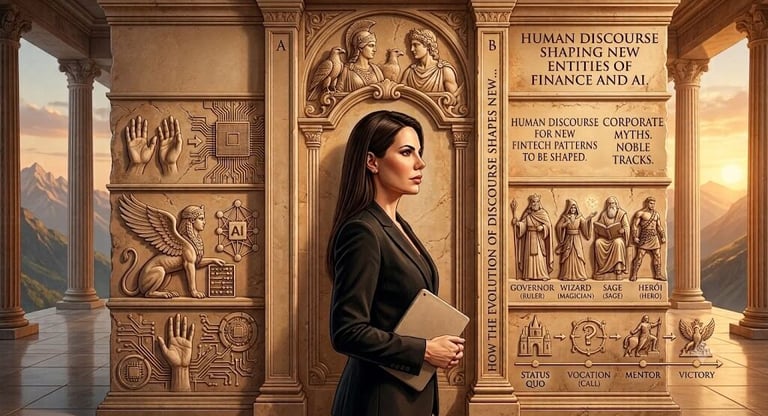

We live in an era of extreme rationality. At the convergence point between the global financial market and the overwhelming advancement of Artificial Intelligence (AI), everything seems measurable, predictable, and optimizable. Predictive models devour petabytes of data in milliseconds to execute high-frequency trading orders; generative algorithms analyze corporate balance sheets, forecast volatility, and automate decision-making across ecosystems of fintechs, investment banks, and venture capital funds.
Faced with such technical sophistication, traditional corporate communication makes a fatal mistake: assuming that human decision-making in the business environment is purely analytical. Far from it. The human mind—even that of a Wall Street managing director or a Silicon Valley machine learning engineer — does not operate primarily through equations or spreadsheet reports. The human mind operates through narratives and myths.
A myth is not a falsehood, an illusion, or an outdated legend. From the perspective of anthropology, analytical psychology, and language science, a myth is the fundamental structure through which humanity bestows meaning upon chaos, establishes moral values, and projects the future. When technology and finance reach levels of complexity that escape the intuitive understanding of the average individual, the need for myth does not diminish; it multiplies.
In ecosystems where financial volatility meets the uncertainty of the technological revolution, an organization's most enduring competitive advantage lies not merely in its proprietary code or cash liquidity. It lies in its ability to embody a strong mythological archetype. Market-leading companies do not merely sell return-on-investment metrics or cloud processing capacity. They offer existential meaning, a worldview, and a role to play in a broader cosmic drama.
This article proposes a deep investigation into the strategic use of archetypes in modern corporate communication. We will analyze how organizations can mobilize ancestral narrative structures to build authority, attract capital, engage complex ecosystems, and humanize the most abstract technologies of our era.
1. Structural Mythology at the Heart of the Market
To understand how myth operates in the corporate world, one must deconstruct the illusion that the financial market and the technology sector are strictly secular environments devoid of ritualism. On the contrary: few human activities are as imbued with symbolism as the creation and exchange of value.
1.1 The Abstract Nature of Money and Algorithmics
Money, in its modern essence, is a linguistic and fiduciary abstraction. A paper bill, a number on a smartphone screen, or a tokenized asset on a distributed network only possesses value because there is a shared narrative of collective trust. The financial market is, therefore, a massive factory of narrative consensus.
Artificial Intelligence has taken this abstraction to a new level. The code behind a large language model or a deep neural network is invisible to the vast majority of people. The public interacts with AI through its effects and the promises of those who build it. It is an almost "magical" force in the anthropological sense: something intangible that alters physical reality.
When two abstract forces — capital and algorithm — merge, corporate communication must act as the symbolic translator of this union. Without a mythic structure, this convergence breeds anxiety, distrust, and rejection. This is where archetypes play their critical role.
1.2 The Concept of Archetype and the Corporate Collective Unconscious
Swiss psychiatrist Carl Gustav Jung postulated that the human unconscious contains inherited, universal, and timeless psychic structures, which he named archetypes. Archetypes are ancestral patterns of energy, motivation, and behavior that manifest through recurring figures in myths, dreams, and fairy tales across every culture in human history.
In the corporate environment, archetypes function as cognitive and emotional shortcuts. When a financial technology brand clearly projects the archetype of the Magician or the Sage, the audience does not need years to grasp that company's value proposition. The mind of the investor, client, or business partner recognizes the pattern instantly because the template for that figure is already encoded within their psychic structure.
High-performance corporate communication does not invent identities from scratch. It discovers, refines, and aligns the company's tone of voice, brand architecture, and discourse with the archetype that best translates its strategic purpose to the market.
2. The Four Dominant Archetypes in the Financial and AI Ecosystem
While there are various archetypal models applied to branding, four figures stand out as the most potent narrative engines for companies operating at the intersection of capital markets and intelligent automation. Each of these figures addresses a profound need and resolves a specific conflict in the psyche of the contemporary consumer and investor.
The archetypal structure of this sector is organized around two major strategic axes. On one side, we have the pursuit of Order and Stability, represented by the Ruler (focused on governance) and the Sage (focused on data-driven truth). On the other, we have the pursuit of Transformation and Vision, driven by the Magician (focused on disruptive innovation) and the Hero (focused on overcoming chaos).
2.1 The Magician: The Alchemy of Code and Abundance
The Magician is the archetype of transformation, of innovation that seems to defy the laws of possibility, and of converting the invisible into the visible. In the context of Finance and AI, the Magician embodies the promise of taking raw, chaotic data and transmuting it into precise predictions and automatically generated wealth.
· Core Promise: "We master the invisible forces of technology to transform how value is created and distributed."
· Voice and Verbal Identity: The Magician's communication is visionary, inspiring, elegant, and assertive. It avoids overly bureaucratic jargon, favoring metaphors of synthesis, elevation, and discovery.
· Practical Application: Fintech companies focused on intelligent portfolio automation, generative AI platforms for asset trading, and cloud infrastructure systems for financial services frequently utilize this archetype. The company positions itself not as a mere software vendor, but as the catalyst for a new paradigm.
2.2 The Ruler (or King): The Guardian of Order and Value
The Ruler is the figure that personifies stability, control, institutional authority, and unwavering governance. In a global financial market characterized by high volatility, inflation, and systemic cybersecurity risks, the Ruler is the safe harbor.
· Core Promise: "We provide the structure, compliance, and security necessary for your wealth to thrive in any scenario."
· Voice and Verbal Identity: The language is sober, institutional, precise, measured, and regulatory-flawless. There is no room for levity, promotional hype, or fleeting slang.
· Practical Application: Central banks, major financial custody institutions, algorithmic audit firms, and AI compliance platforms for the financial sector. When AI technology is deployed under this archetype, the narrative focuses not on "wild disruption," but on "surgical precision and absolute risk mitigation."
2.3 The Sage: The Oracle of Data and Truth
The Sage is driven by the unyielding quest for knowledge, objective truth, and a deep understanding of how the world works. In an era saturated with disinformation, market noise, and superficial analysis, the Sage stands out as a beacon of critical intelligence.
· Core Promise: "We process the world's noise to deliver the clarity and truth you need to make the best decisions."
· Voice and Verbal Identity: Analytical, grounded, transparent, educational, and methodical. The Sage's tone of voice does not appeal to cheap emotion, but to the listener's intellect. It uses statistical data, scientific papers, white papers, and logically structured arguments.
· Practical Application: Business intelligence firms, AI-powered financial data terminals, strategic language consultancies, and predictive analysis tools for quantitative funds. The value of this archetype lies in trustworthy neutrality and information rigor.
2.4 The Hero: The Conqueror of Chaos and Inefficiency
The Hero is the figure of endurance, courage, and the fight against a visible enemy or a major market injustice. In the financial and tech environment, the "dragon" to be slain is almost always bureaucratic inefficiency, exorbitant legacy fees, or time wasted on obsolete manual processes.
· Core Promise: "We confront the complexity and abuses of the traditional system to give you power and victory in the market."
· Voice and Verbal Identity: Energetic, motivating, action-oriented, direct, and resilient. It uses imperative verbs, striking slogans, and a clear "before and after" or "us versus inefficiency" narrative.
· Practical Application: Challenger fintechs (neobanks), zero-commission digital brokerages, AI tools focused on extreme analyst productivity, and projects that democratize access to financial tools previously restricted to major institutional players.
3. The Corporate Hero's Journey: Structuring the Finance and AI Narrative
Identifying the correct archetype is only the first step. For the myth to come alive and mobilize the ecosystem, it must be deployed into a dynamic narrative structure. The most powerful conceptual tool for this purpose is the Hero's Journey (or Monomyth), formulated by mythologist Joseph Campbell.
In modern corporate communication, the company should rarely position itself as the primary "Hero" of the story. The true hero of the narrative is the client, investor, or technology user. The organization assumes the role of the Mentor — the wise master (like Gandalf or Yoda) who bestows upon the hero the magic sword or treasure map (in this case, AI technology or the financial solution) so that they may overcome their own challenges.
3.1 The Stages of the Journey Applied to Business
1. The Ordinary World (The Inefficient Status Quo): The client lives in an environment of slow financial processes, mediocre yields, excessive bureaucracy, or an inability to process their company's volume of data.
2. The Call to Adventure (Market Uncertainty): The rise of new technologies or regulatory changes forces the client to seek new solutions. They realize that continuing to act the old way will lead to stagnation or ruin.
3. Meeting the Mentor (The Entry of the AI/Finance Firm): The organization introduces itself to the client. Through its verbal identity and archetypal positioning, the Mentor demonstrates authority, empathy, and deep knowledge of the Hero's challenges.
4. Crossing the Threshold / Receiving the Elixir (Solution Implementation): The Mentor equips the Hero with the algorithm, platform, or intelligent credit model that solves the core problem.
5. The Ultimate Ordeal and Return with the Elixir (Market Victory): The client uses the technology to outperform competitors, optimize capital, and achieve new standards of efficiency and security. They return to their market as a transformed leader.
When corporate communication consistently builds this journey across sustainability reports, investor pitch decks, marketing campaigns, and press releases, the company ceases to be a mere vendor of tech commodities and is instead perceived as an indispensable strategic partner.
4. Language Engineering and Mythological Governance in Practice
An archetype does not survive on a mission statement posted on a corporate website alone. It must be embodied in everyday syntax, vocabulary, and communication rules. This is where Language Engineering acts as the technical bridge between the abstraction of myth and the execution of automated and human corporate communication.
4.1 The Danger of a Fractured Archetypal Alignment
One of the greatest risks to the reputation of Finance and AI brands is a fractured verbal identity. This occurs when a company tries to be everything to everyone at once, blending contradictory archetypal signals across its communication ecosystem:
· If a company publicly positions itself under the Ruler archetype (promising maximum security and institutional sobriety), but its customer support chatbots respond with casual slang and internet jokes (attempting to act like the Jester or the Innocent), client trust is destroyed at a subconscious level.
· If a financial AI startup adopts the Sage narrative in investor presentations but delivers automated reports riddled with hallucinations, grammatical errors, and unverified magical promises (straying into the Trickster), institutional capital withdraws immediately.
4.2 Voice Governance in Generative AI Systems
As companies automate report generation, customer service, and content creation through language models, archetypal governance becomes a top-tier strategic priority.
To maintain corporate myth integrity at scale, organizations must implement strict prompt engineering rules and governed knowledge bases that ensure:
· Archetypal Lexicon Filters: Clear definitions of approved and forbidden vocabulary for generative AI, ensuring the brand's tone of voice remains strictly faithful to the chosen archetype across all touchpoints.
· Syntax and Pace Control: Adjusting the complexity and length of system-generated sentences to mirror the archetypal personality. The Sage uses more elaborate, explanatory sentence structures; the Hero prefers short, dynamic, direct sentences.
· Exception and Crisis Management: Specific instructions on how AI should behave during technical outages, market volatility, or data breaches. In these moments, the tone of voice must immediately pivot to the responsibility and sobriety of the Ruler, without losing human empathy.
5. The Strategic Impact of Archetypes on Ecosystem Leadership
Market leadership in the 21st century is not exercised in isolation. The world's largest companies are not merely businesses; they are ecosystem orchestrators involving developers, regulators, commercial partners, venture capitalists, and a loyal user base.
Constructing a strong mythological archetype is what unifies this heterogeneous ecosystem. It acts as a gravitational force of attraction.
5.1 Capital Attraction and Valuation
Capital is not neutral; it seeks security or high-impact growth. Investment funds and institutional investors allocate resources based on future expectations. When an AI and Finance firm successfully communicates its vision through the archetype of the Magician or the Ruler, it reduces perceived risk and elevates its pricing power.
Companies with clear archetypal identities tend to secure higher valuations during funding rounds and initial public offerings (IPOs), as the market prices in not only current discounted cash flow, but the strength and sustainability of the brand narrative over the long term.
5.2 Engaging Technical and Scientific Talent
The competition for talent in Artificial Intelligence, Data Science, and Financial Engineering is among the fiercest in the global economy. Highly qualified professionals are not driven solely by astronomical salaries; they seek to work on projects with a clear purpose and meaningful challenges.
A strong archetype transforms corporate recruitment into a "call to adventure." Working at a company embodying the Sage archetype means standing at the frontier of human knowledge; working at a company with the Hero archetype means building the tools that will revolutionize an outdated financial system. Corporate mythology is the ultimate tool for attracting and retaining brilliant minds.
5.3 Relationships with Regulators and Society
The advancement of AI and digital finance inevitably draws the watchful eye of regulators and lawmakers. Companies adopting an arrogant or opaque communicative stance face greater scrutiny and harsher penalties.
By adopting an archetypal communication strategy anchored in the Ruler or the Sage, an organization demonstrates maturity, respect for the law, and a commitment to the sustainable development of the ecosystem. Transparent, ethical language reduces regulatory friction and positions the company as a credible voice in shaping industry standards.
Conclusion: Myth as the Most Human Technology
Ultimately, technology and finance are human creations designed to serve human purposes. As we move deeper into the era of artificial intelligence, where code gains autonomous decision-making capacity and digital assets flow across invisible networks, the real danger is not machine automation, but the erosion of humanity in communication.
Myth is not the opposite of reason; it is its frame. An archetype is not a superficial mask; it is the symbolic essence of who an organization is and the role it has chosen to play in history.
Leaders who master the power of myth in corporate communication will not only build more valuable and sustainable brands. They will be fulfilling the highest function of corporate language: translating technical progress into human meaning, mutual trust, and shared prosperity. In the hyper-connected ecosystem of Finance and AI, technology may be the engine, but myth will forever remain the helm.


