
Storytelling of Language: What Narratives Can Teach Us About the Perpetuation of Corporate Brands
The Hidden Power of the Word: How Narrative Structure Shields Corporations Against Time
LITERARY CRITICISM & GLOBAL CULTURE
By Fabiana Barros | Language Scientist & CEO for Digital Language Solutions
7/20/2026
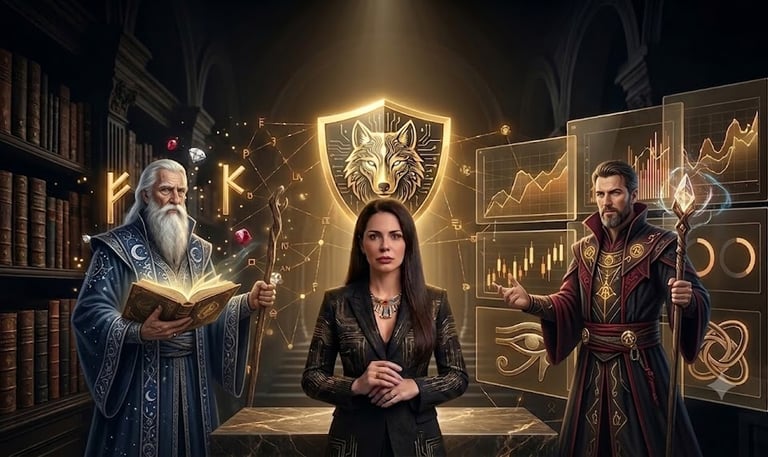
Since the dawn of civilization, human survival has been closely linked to the ability to transmit knowledge through stories. Long before the invention of writing or the consolidation of modern capital markets, societies gathered to share teachings that shaped the group's identity and guaranteed its continuity for generations to come. This phenomenon was no mere pastime; it was a mechanism of biological, social, and existential preservation.
In the contemporary landscape, where technology advances exponentially and artificial intelligence algorithms redefine the boundaries of communication, large corporations face a challenge very similar to that of ancient peoples: how not to dissolve amidst the noise of an era saturated with stimuli?
The answer to this question does not lie in tangible assets, balance sheets, or isolated technological patents. The true secret of corporate longevity dwells in semiotics, specifically in the ability to build a linguistic brand identity grounded in a deterministic and immutable storytelling framework.
When we analyze brands that cross centuries without losing their sovereignty and market value, we realize they do not sell products, but rather worldviews. They use natural language as a programming code capable of shaping human perception, generating a sense of loyalty that transcends the utilitarian logic of consumption.
Understanding how these narratives are structured is the first step toward transforming an ordinary company into an undying institution. For institutional investors seeking security, this communicative solidity is the ultimate indicator of corporate maturity.
1. The Anatomy of Myths and Alternative Investment Strategies
To understand how a corporate narrative perpetuates a brand, one must investigate the universal patterns of storytelling. Great scholars have mapped narrative cycles that repeat across virtually every culture around the globe. This pattern resonates deeply within the collective unconscious because it reflects the very processes of transformation, overcoming, and growth that all human beings experience.
In the universe of major brands, archetypes play the role of psychological anchors. A corporation that masters its own verbal identity knows exactly which force it embodies in the global market.
· The Sage: Holder of deep technical knowledge and indispensable methodological precision.
· The Magician: Transforms reality through disruptive innovation and cutting-edge linguistic engineering processes.
· The Ruler: Exudes power, senior governance, stability, and an aristocratic heritage that shields its reputation against any market volatility.
The mistake of most nascent companies and even some modern fintechs is believing that communication should be purely informative or transactional. By focusing solely on technical benefits or return rates, the organization addresses only the client's rational mind — a superficial and highly volatile cognitive layer.
On the other hand, when language is infused with archetypal symbols, the message penetrates directly into the emotional and intuitive layers of the listener. The narrative creates a magnetic field of attraction where the consumer stops merely closing a deal and starts belonging to a clan. It is this perception engineering that validates interest in alternative investment strategies, where brand value dictates the price of the asset.
2. Linguistic Couture: Haute Couture and the Verbal Identity of Luxury Brands
The perpetuation of a brand requires that every word, phrase, manifesto, or executive statement be treated as an element of linguistic haute couture. In a hyper-competitive international ecosystem, corporate tone of voice cannot be left to chance or at the mercy of seasonal trends. It requires strict governance that clearly establishes permitted terms, prohibited concepts, and the ideal cadence of leadership communication.
A linguistic brand establishes what specialists call the semiotics of power. This means that the choice of an adjective or the structure of a metaphor in an institutional report does not merely describe a fact, but projects authority instead.
While ordinary brands use a robotic, generic, and excessively technical language to explain their processes, the verbal identity of luxury brands and sovereign corporations utilizes a sophisticated prose that evokes tradition, mystery, and absolute technical mastery.
This verbal precision functions as a shield for linguistic compliance. In the era of generative artificial intelligence, where any tool can produce massive blocks of empty, soulless text, the originality of the human tone of voice and neurolinguistic sophistication become the ultimate market differentiators. Corporations that possess this unique verbal signature become instantly recognizable, even if their logos or corporate colors are omitted. Their narratives carry their own cellular identity.
3. The Trust Loop and Corporate Reputation Crisis Management
The capital market and major international investors operate on a single invisible, yet vital asset: trust. Trust is not a static statistical data point; it is a dynamic narrative told and retold every day across communication channels, negotiation tables, and governance reports. When a reputation crisis hits an institution, the battle is not fought in courtrooms or vaults, but in the field of semantics.
Organizations that master structured storytelling possess an infinitely greater capacity to mitigate risks and neutralize image liabilities. This happens because they have already integrated volatility and challenge as natural parts of their own mythical saga.
When a sovereign company faces adversity, senior leadership does not position itself defensively or cornered. Instead, it uses language to reframe the event, transforming the problem into a necessary chapter of evolution, strengthening, and reaffirmation of its core values.
Governance dictates that the response for corporate reputation crisis management be calibrated with temperance and poise. The surgical use of the correct words dissipates market uncertainty, calms shareholders, and prevents artificial panic from contaminating the intrinsic value of the company's assets. A brand without a solid foundational narrative crumbles at the first sign of a verbal storm; a brand shielded by excellent storytelling uses the storm to further polish its institutional gold.
4. The Fusion of Intelligences and Process Optimization Systems
As we move into a future where artificial intelligence takes operational control of most automated writing and data analysis tasks, natural intelligence assumes the role of sovereign curator of meaning. The machine is extraordinarily efficient at processing patterns, but it lacks the intrinsic capacity to generate metaphysical meaning or to comprehend the nuances of the human soul that make a story truly magnetic.
Vanguard corporate thinking, therefore, requires the perfect fusion of these two forces. Technological tools serve as an infrastructure for scale and optimization, capable of swiftly distributing the message across multiple global digital channels. However, the direction of this message, the essence of the myth, and the refinement of the linguistic brand must remain under the strict control of language scientists and strategists who master the deep codes of human communication.
Fintechs and governance firms wishing to capture large-scale budgets in the international market must understand that technological process optimization systems alone can become commoditized.
The software a company uses today can be copied or outperformed by the competition tomorrow. However, the verbal architecture that anchors that company's reputation in the collective imagination is completely inimitable. Storytelling is the only asset that gains value and density over eras, transforming volatile capital into an intergenerational historical patrimony.
5. The Immutable Legacy of the Word in the Global Market
Narratives are not mere ornaments to illustrate a corporation's success; they are the invisible foundations upon which an entire business empire is built. From ancient writings that codified intentions of wealth and power to the sophisticated verbal identity manuals of the largest contemporary corporations, the purpose of language remains exactly the same: to manifest human intention, govern trust processes, and guarantee the immortality of a legacy.
When structuring their channels, reviewing their content, and designing their value propositions for high-end decision-makers, corporate leaders must always ask themselves what deep story their organization is telling the world.
If the story is generic, the brand will be forgotten as soon as the next technological wave emerges. If the story is mythical, authentic, refined, and driven by a clear methodology from beginning to end, the corporation will cease to be just a market participant and will become an eternal institution.
The written and spoken word is the ultimate tool of sovereignty. Those who hold scientific mastery over the construction of these narratives hold the keys to open the doors to the world's largest value auctions, attracting major investors, shielding assets, and perpetuaiing brands through the centuries.


