
Knowledge-Based Prompt Engineering: Injecting Human Wisdom into High-Performance Synthetic Systems
The End of the "Mirror Prompt" and the Era of Cognitive Architecture
ENGENHARIA LINGUÍSTICA DE PROMPTS
By Fabiana Barros | Language Scientist & CEO Intellectual Solutions for Digital Language
7/16/2026

In the early days of the popularization of generative artificial intelligence, prompt engineering was treated almost as a mystical art or an exercise in psychological persuasion. Manuals proliferated across the internet suggesting formulas based on "asking politely," "offering virtual tips to the model," or drafting generic imperative commands such as "act as a senior copywriter". This rudimentary approach, which we can call the mirror prompt, relies on luck: the user throws a vague phrase at the machine and hopes that, by pure statistical probability, it reflects something resembling a flash of intelligence.
In high-performance corporate environments, however, the "mirror prompt" is a dangerous operational liability. It generates inconsistent results, silently propagates hallucinations, and consumes precious computing resources and human auditing time.
The maturity of AI systems demands a radical transition to Knowledge-Based Prompt Engineering (KBPE). This is a software engineering and computational linguistics discipline whose objective is to design context interfaces that systematically, structurally, and deliberately inject the wisdom accumulated by human experts — whether domain ontologies, proprietary heuristics, governance rules, or cognitive frameworks — directly into the synthetic model's inference cycle.
We are no longer instructing the model on what to do, but rather temporarily reconfiguring its attention architecture through the provided context, transforming a statistical generalist into a high-precision niche specialist.
I. The Epistemological Abyss: Parametric Memory vs. Non-Parametric Memory
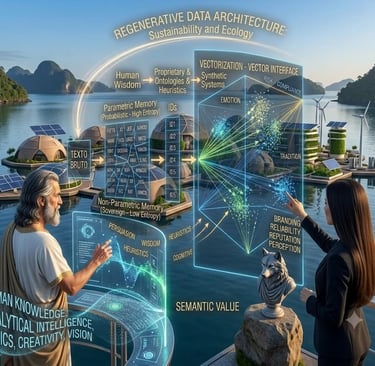
To understand the impact of injecting prior knowledge into a prompt, we must separate the synthetic mind into two fundamental memory layers:
· Parametric Memory ($\theta$): This is the knowledge frozen in the model's weights during its pre-training and fine-tuning phase. It contains the global patterns of language, internet clichés, public data, and average syntactic structure. It is vast but static, imprecise for niche details, and highly prone to empty generalizations.
· Non-Parametric Memory ($K$): This is the dynamic knowledge provided on demand at the moment of inference (user input, documents retrieved by RAG, real-time databases, or explicit heuristics). It is precise, instantly updatable, auditable, and sovereign.
When an analyst sends a prompt without structured prior knowledge, they are forcing the model to navigate exclusively through its Parametric Memory. The probability of obtaining a generic term or a factual hallucination is expressed mathematically by the entropy of the token probability distribution:
$$P(w_t \mid w_{<t}, \theta)$$
When we apply Knowledge-Based Prompt Engineering, we introduce an external semantic restriction ($K$). The prediction probability of the next token becomes conditioned by this informative force field:
$$P(w_t \mid w_{<t}, \theta, K)$$
This process drastically reduces the semantic entropy of the system, forcing the attention vectors to collapse specifically around the coordinates of the injected knowledge.
To fully understand this dynamic, it is essential to contrast in a discursive manner the abyss that separates the traditional approach (based on vague instructions or roleplay simulations) from the paradigm grounded in structured knowledge.
Regarding the source of knowledge, conventional prompt engineering depends strictly on the statistical average of what the model assimilated during its public pre-training. The result is a text that repeats the market's common sense. On the other hand, knowledge-based prompt engineering anchors itself in heuristics built by highly qualified human brains, proprietary ontologies, and compliance data that the model would otherwise never have access to.
This difference in origin drastically alters the attention architecture of the artificial intelligence during response generation. Without rigid factual boundaries, the model's attention weights float freely through the vector space, tracing connections that sound plausible but lack logical foundation. When prior knowledge is injected as a restrictive track, the model is forced to channel its attention almost exclusively onto the provided data and rules, generating an intentional and healthy collapse of probabilistic options.
As a direct consequence of this containment, the system's hallucination rate plummets. In complex tasks or those of high technical specificity, where traditional prompts repeatedly fail by inventing facts to fill cognitive gaps, the approach based on prior knowledge reduces the margin of error to insignificant levels, since the scope of acceptable truth has been rigidly delimited by the human designer.
This containment also stabilizes output consistency. Common prompt writing tends to produce highly volatile responses, where a small word change in the user's query alters the entire tone or technical rigor of the output. With structured prior knowledge guidelines, the model begins to operate deterministically, ensuring the same standard of excellence and conceptual fidelity regardless of variations in the initial stimulus.
Finally, this entire controlled ecosystem has a direct and positive impact on human auditing costs. While the output of a freely operating AI requires an exhaustive and tense review by experienced auditors to hunt down subtle inconsistencies, the results of knowledge-based engineering are audited with extreme speed. The human reviewer ceases to be a hunter of mechanical lies and starts acting as a validator of conceptual compliance, knowing that the boundaries imposed by the guidelines prevent the most severe technical deviations.
II. The Anatomy of Knowledge Injection: Heuristics and Scaffolding
Injecting human wisdom into a synthetic system does not simply mean pasting a 50-page PDF into the prompt and asking it to "summarize this." The mechanical brain of Transformers suffers from a loss of attention in the middle of the context (Lost in the Middle). Therefore, structuring information requires a method of Cognitive Scaffolding and the formulation of Declarative and Procedural Heuristics.
┌────────────────────────────────────────────────────────────────────────┐
│ COGNITIVE SCAFFOLDING STRUCTURING │
├────────────────────────────────────────────────────────────────────────┤
│ 1. Domain Ontology ➔ Defines concepts and limits of what is real │
│ 2. Practical Knowledge ➔ Determines "How-To" (Procedural Knowledge) │
│ 3. Operational Limit ➔ Delimits ethical and technical boundaries │
│ 4. Auditing Mechanism ➔ Forces the AI to justify logical steps │
└────────────────────────────────────────────────────────────────────────┘
1. Declarative Knowledge (The Domain Ontology)
The first step of KBPE is to delimit the ontology. If we are creating an assistant for troubleshooting structural failures in aircraft turbines, the prompt must contain an exact dictionary of causal relationships accepted by that company's engineering team, preventing the model from deciding to invent alternative, fanciful explanations based on its parametric memory.
"Turbine Model X presents only three primary structural failure modes: Critical Thermal Wear (CTW), Rotary Axial Misalignment (RAM), and Pressure Blade Fatigue (PBF). Any reported symptom outside this triad must be strictly categorized as an 'Unmapped Anomaly'."
2. Procedural Knowledge (The Heuristic Decision Tree)
Human knowledge rarely boils down to static concepts; it manifests in processes. Injecting procedural wisdom into the prompt consists of guiding the machine's reasoning through rigid logical execution steps, inspired by the behavior of human experts under pressure.
To do this, we modify the model's attention score calculation by inserting a conceptual bias matrix ($B$), which acts as a guide rail for logical connections:
$$\text{Attention}_{KB}(Q, K, V) = \text{softmax}\left(\frac{QK^T + B}{\sqrt{d_k}}\right)V$$
In practice, this translates into structuring the prompt not as a direct command, but as a cognitive recipe that forces the execution of intermediate steps of thought before formulating the final answer:
Markdown
[PROCEDURAL REASONING DIRECTIVE]
Upon receiving a clinical case, you must execute the following steps in this exact sequence:
1. Isolate the symptoms into standardized medical terms (De-noising).
2. Cross-reference each symptom with the pathology table in Appendix A.
3. Formulate three competing hypotheses with their respective plausibility weights.
4. Write a counter-argument challenging your own primary hypothesis.
5. Produce the final diagnostic conclusion.
III. Design Patterns in KBPE: Practical Solutions to Complex Challenges
The practical application of this paradigm has led us to consolidate highly effective prompt design patterns to mitigate failures in enterprise-level production systems.
1. The "Dual-Core" Pattern (Persona + Rigid Knowledge Base)
One of the most common architectural errors is mixing stylistic behavior instructions (voice, tone, formatting) with factual technical knowledge. In the Dual-Core pattern, we divide the prompt into two isolated and shielded cores:
· The Execution Core (The Actor): Defines the rules of style, character limits, tone of voice, and output format (JSON, Markdown, text).
· The Truth Core (The Oracle): Contains the unquestionable factual base, compliance rules, and human prior knowledge. The Actor is strictly prohibited from using any fact that cannot be derived by direct logical deduction from the content exposed by the Oracle.
2. The "Semantic Drift Prevention" Pattern
When language models write long texts, a phenomenon called "semantic drift" occurs: the initial paragraphs are highly aligned with the prompt, but as the text progresses, each new generated sentence serves as context for the next ones, creating an internal "whisper game" effect that degrades the accuracy of the information.
The Drift Filter pattern consists of forcing the AI to perform a "validation checkpoint" after every paragraph written:
"At the end of each generated section, secretly insert a hidden comment evaluating whether the last statement made violates the premises contained in the 'Prior Knowledge' section. If a violation is detected, restart the generation of that section immediately."
IV. Practical Implementation: The Knowledge Injection Pipeline in Python
To illustrate how Knowledge-Based Prompt Engineering operates within a real data ecosystem, we present below the code for a hybrid processing engine.
This Python script simulates the operation of a financial services pipeline. Before sending the user's question to the language model, the system intercepts the request, analyzes the intent, consults an internal repository of validated human knowledge (an investment ontology and compliance rules), and dynamically builds a shielded and highly instructed prompt.
Python
import os
from typing import Dict, Any
class KnowledgePromptEngine:
def init(self):
# Human Wisdom Repository (Proprietary ontology and rigid business rules)
self.knowledge_base = {
"high_risk_investments": (
"Compliance Rule: Clients with a conservative profile are prohibited from "
"receiving recommendations for cryptoassets, derivatives, or futures contracts. "
"Any mention of these assets to conservative profiles will generate a compliance breach."
),
"taxation_rules": (
"Fiscal Heuristic: For long-term investment funds, the progressive "
"withholding tax rates vary from 22.5% (up to 180 days) to 15% (above 720 days). "
"Never round these rates."
)
}
def detect_intent(self, user_query: str) -> str:
"""Simple semantic intent classification simulation."""
query_lower = user_query.lower()
if "risk" in query_lower or "conservative" in query_lower or "crypto" in query_lower:
return "high_risk_investments"
if "tax" in query_lower or "taxation" in query_lower or "ir" in query_lower:
return "taxation_rules"
return ""
def assemble_prompt(self, user_query: str, client_profile: Dict[str, Any]) -> str:
intent = self.detect_intent(user_query)
injected_knowledge = ""
# Dynamic injection of knowledge based on detected intent
if intent in self.knowledge_base:
injected_knowledge = self.knowledge_base[intent]
print(f"[LOG] Prior knowledge successfully injected for intent: '{intent}'")
else:
print("[LOG] No mapped proprietary heuristic. Using general safeguards.")
injected_knowledge = "Keep answers restricted to the general principles of personal finance."
# Construction of the Prompt Based on Cognitive Scaffolding (Dual-Core)
prompt = f"""
================================================================================
CORE 1: THE ORACLE (COMPLIANCE KNOWLEDGE BASE - DO NOT DEVIATE)
--------------------------------------------------------------------------------
You are a shielded corporate financial support system.
Your sole source of truth for business rules and decision-making is the information below:
- Client Data: Risk Profile = {client_profile.get('profile', 'Not Provided')}, Equity = USD {client_profile.get('equity', 0):,.2f}
- Injected Knowledge: {injected_knowledge}
Maximum Rule: If the user's query requests or suggests anything that violates the knowledge base above,
politely refuse the request, explaining the exact fiscal or compliance reason.
================================================================================
CORE 2: THE ACTOR (TONE OF VOICE AND OUTPUT FORMAT)
--------------------------------------------------------------------------------
- Tone: Highly professional, precise, sober, and explanatory.
- Output: Structured Markdown format. No empty introductions or robotic greetings.
- Response Process:
1. Identify the client's profile and display the applied compliance rule.
2. Present the analytical resolution of the query.
3. Finalize with a regulatory compliance notice.
================================================================================
USER QUERY: "{user_query}"
================================================================================
"""
return prompt
# Practical Pipeline Test
if name == "__main__":
# Case 1: Conservative client trying to access high-risk assets
conservative_client = {"profile": "CONSERVADOR", "equity": 250000.00}
user_question = "I would like to allocate 20% of my portfolio to Bitcoin to diversify. How should I proceed?"
engine = KnowledgePromptEngine()
final_prompt = engine.assemble_prompt(user_question, conservative_client)
print("\n--- GENERATED HIGH-PERFORMANCE PROMPT ---")
print(final_prompt.strip())
This architectural example demonstrates that a high-performance prompt is no longer a static text that the user copies and pastes. It is a software artifact assembled at runtime, powered by live data and governed by logical guidelines conceived by engineers and business experts.
V. The Return on Wisdom: Economic Analysis of Information Density
IT professionals and CFOs frequently question the costs associated with advanced prompt engineering. It is true that prompts based on prior knowledge are longer and, consequently, consume more input tokens, slightly increasing the raw cost of each individual API call.
However, this isolated analysis is a financial illusion. When we calculate the Total Cost of Semantic Ownership (TCSO) of a system based on generative AI, the mathematics reveal that KBPE is incomparably cheaper.
Let the cost equation for producing a valid corporate document through AI be:
$$\text{Total Cost} = N_{\text{interactions}} \times (\text{Token Cost} + \text{Human Auditing Cost})$$
· In the "Mirror Prompt" model (Without Prior Knowledge): The input token cost is low, but the number of interactions ($N$) required to achieve acceptable quality is huge (usually between 3 to 5 frustrated attempts by the user correcting the model). In addition, the human auditing cost of each output is extremely high, since the probability of subtle and dangerous errors is elevated.
· In the Knowledge-Based Prompt Engineering model: The initial token cost is marginally higher, but the number of interactions drops to $1$ in the vast majority of cases. More importantly: human auditing costs drop drastically because the model's behavior becomes predictable and parameterized by the heuristics injected into the prompt.
Analyzing the practical impact on human labor efficiency, the paradigm shift becomes evident. In terms of the first-attempt success rate—also known in the tech market as the One-Shot rate—systems that do not use structured knowledge injection achieve an alarming average of only 20% accuracy in their initial answers, forcing human collaborators into a tiring cycle of iterative corrections. In contrast, models controlled by KBPE consistently achieve up to 90% compliance on the first try.
This increase in precision generates direct savings in team workloads. For each complex document generated via traditional methods, the average time a senior professional spends reading, correcting invented facts, and polishing vocabulary to make it acceptable revolves around 16 minutes. When cognitive constraints are strictly applied to the core of the synthetic intelligence, this human review time drops to a mere 4 minutes per file. In the overall context of a large-scale business operation, this difference translates into hundreds of hours of productivity returned to business specialists.
Injecting human wisdom into the context is not just a stylistic whim; it is an investment in computational efficiency and a drastic reduction in corporate operational risk.
VI. The Future of KBPE: From Prompt Writing to Autonomous Context Management
As the context window limits of language models expand from thousands to millions of tokens, the role of the traditional prompt engineer continues to undergo a profound mutation. The professional of the future will not be the one who masterfully commands a list of "magic words" to extract good answers from an AI. The AI engineer of the future will be the guardian of organizational context.
Their responsibility will be to translate a company's intellectual capital—its years of successes and errors, its technical operating manuals, its corporate legal culture, and its proprietary methodologies — into dynamic context matrices capable of being coupled and decoupled on demand in the cool mind of neural networks.
Human knowledge will no longer simply be read by computers; it will be structured in such a way that it will serve as the cognitive operating system of synthetic intelligences themselves.
Conclusion: Human Sovereignty in the Inference Space
Knowledge-based prompt engineering restores the role of absolute leadership to human beings in the digital age. It rescues the value of the senior professional and the domain specialist in the face of the rapid advance of entry-level automation.
An artificial intelligence capable of processing billions of calculations per second and correlating terms in thousands of dimensions is of no use if it does not have conceptual tracks to guide it toward practical utility and business compliance. The synthetic model provides the speed, the computational muscle, and the infinite capacity for scaling; we provide the direction, the rules of the game, and the ethical sensitivity.
By injecting our wisdom clearly, methodically, and structurally into the heart of high-performance artificial systems, we cease to be mere spectators of machine decisions. We assume, with uncompromising sovereignty, the role of supreme architects of the artificial minds we created to extend the boundaries of our own potential.


