
From Classical Literature to Business Strategy: How Classical Rhetoric Saves Modern Copy from Death by Indifference
The Epidemic of Sameness and Modern Consumer Fatigue
LITERARY CRITICISM & GLOBAL CULTURE
By Fabiana Barros | Language Scientist & CEO Intellectual Solutions for Digital Language
7/13/2026
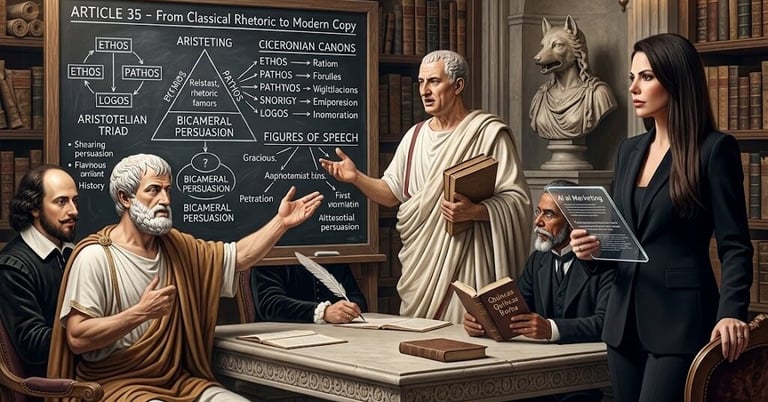
The contemporary digital marketing ecosystem suffers from a silent but highly lethal disease: death by indifference. Every single day, billions of users scroll through yards of social feeds, encountering dozens of landing pages, conversion emails, and sponsored ads. Yet, the overwhelming majority of this content glides across the audience’s visual cortex without leaving the slightest trace of cognitive impact. Brands spend fortunes on paid traffic, only to watch their return on investment plummet as psychological resistance rises like an insurmountable wall.
This paralysis is no accident; it is the direct result of a profound technical degradation. With the democratization of generative Artificial Intelligence tools and the proliferation of cookie-cutter copywriting frameworks — such as the tired AIDA (Attention, Interest, Desire, Action) or PAS (Problem, Agitation, Solution) models —persuasive writing has been reduced to an industrial, fill-in-the-blank exercise. Business copy has become predictable, sterile, and, above all, soulless. Consumers have learned to smell aggressive marketing from miles away, developing a highly defensive selective blindness.
The escape route from this marketing dead-end does not lie in new algorithm optimization tricks or temporary "neurocopywriting" hacks found in airport business books. The true lifesaver rests upon a technology refined over two thousand five hundred years of empirical testing in public squares: Classical Rhetoric. From Aristotle to Cicero, from the assemblies of Ancient Greece to the courts of the Roman Empire, the art of moving human will through the written and spoken word has always been the supreme discipline of history’s most brilliant minds.
This article proposes an intellectual and practical bridge between great classical literature, the pillars of ancient rhetoric, and modern business strategy. We will demonstrate how the sophistication of classical language can rescue modern copy from its state of lethargy, transforming forgetful commercial messages into memorable manifestos of brand positioning and high conversion.
I. The Aristotelian Triad as an Existential Conversion Funnel
In the fourth century BC, in his monumental work Rhetoric, Aristotle categorized the three modes of persuasion an orator can use to influence an audience: Ethos (character), Pathos (emotion), and Logos (reason). In the utilitarian haste of modern direct-response marketing, businesses frequently distort or completely neglect the balance of this triad. They often hyper-inflate Pathos using manufactured scarcity and artificial urgency, or rely on a fragile Logos consisting of cherry-picked, out-of-context data.
To save a piece of communication from indifference, the modern strategist must redefine these three classical concepts, viewing them not as isolated tools, but as organic stages of a true existential conversion funnel.
· Ethos (Authority and Character): Solves the question: Why should I listen to you? It establishes security, credibility, and trust before any offer is made.
· Pathos (Emotional Connection): Solves the question: Why does this matter to me? It taps into deep-seated human desires, values, and tensions.
· Logos (Rational Proof): Solves the question: How do you prove what you say? It provides the logical framework, case studies, and systemic proof that justify the decision.
1. Ethos: The Construction of Three-Dimensional Authority
Ethos is the very foundation of any persuasive act. Before your audience can comprehend your proposal or be moved by your narrative, they judge your credibility. In the digital environment, Ethos is frequently confused with a cheap display of ostentatiousness: rented sports cars, screenshots of Stripe dashboards, and power poses in glass-walled offices. This is a shallow caricature of authority.
Classical rhetoric teaches that a solid Ethos is composed of three cardinal virtues perceptible in one's discourse:
· Phronesis (Practical Wisdom): The demonstration of real competence, technical mastery, and the ability to solve complex problems with pragmatism. It is showing, not
just telling, that you know the rules of the game.
· Arete (Moral Virtue): The integrity, ethics, and transparency of intentions. It shows the audience that the speaker is playing a long-term game and values truth over a quick transaction.
· Eunoia (Goodwill): A genuine disposition to help the interlocutor, placing the client’s success and well-being above the immediate sale.
When a brand establishes its Ethos on these three pillars, it eliminates the initial friction of the sale. The client does not feel hunted by a starving salesman, but rather advised by a trusted mentor.
2. Pathos: The Activation of Deep Passions
The mistake modern copywriting makes when working with Pathos is appealing to shallow, vulgar emotions. Anger induced by cheap online controversies and anxiety generated by fake "only 2 spots left" deadlines create a toxic state of alertness. While this might trigger a short-term micro-conversion, it ultimately decays the long-term relationship with the client.
Classical Pathos operates by identifying the existential tensions of the audience. The great business strategist does not sell management software by appealing to the fear of bankruptcy; instead, they appeal to the desire for sovereignty, reclaimed sleep, and the pride of building a lasting family legacy. To evoke true Pathos, the copy must make the reader see themselves as the hero of a classical narrative, where their pain is not merely a line-item bottleneck, but a profound obstacle to their personal character development.
3. Logos: The Unshakeable Logical Skeleton
Emotion captures attention and initiates movement, but reason signs the check. Logos is the argumentative structure that sustains the copy's promise. Without a robust Logos, the enthusiasm generated by Pathos evaporates the moment the user closes the browser tab to "think about it."
In classical rhetoric, Logos is constructed through enthymemes (deductive syllogisms where one of the premises is implicitly shared with the audience) and historical or practical examples. Translated to business reality, this means your product must not simply boast "amazing benefits," but must present an indisputable logical chain of cause and effect:
"If your company spends more time organizing data than executing strategy, and if our system centralizes and automates this data flow into a single dashboard, then, by pure logical consequence, your team will reclaim the hours needed to focus entirely on generating revenue."
The clarity of this premise removes the intellectual objections of the corporate decision-maker.
II. The Ciceronian Canons Applied to the Architecture of Persuasion
Marcus Tullius Cicero, the greatest orator of the Roman Empire, systematized the creation of persuasive discourse into five distinct stages, known as the Five Canons of Rhetoric. Although originally created for political speeches in the Senate and legal defenses in the Forum, these canons offer a perfect process-engineering map for producing complex, high-performing modern marketing campaigns.
By analyzing the journey of an idea from conception to the final copy read by a client, we can redefine the three primary canons under a strictly commercial lens.
1. Inventio (The Discovery of Arguments)
Inventio is the mining phase of ideas. The fatal mistake of most marketing agencies is jumping straight to writing without first excavating the foundational arguments. Cicero never began writing a speech without thoroughly researching every facet of the case, the background of the parties involved, and the psychological makeup of the judges.
In a corporate context, Inventio represents deep market research and thesis definition. It is the moment to map out what we call the "inconvenient truth" of your niche:
· What are the comfortable lies your competitors are selling?
· What is the raw wound in the industry that no one has the courage to touch?
· What is the core conflict of interest the client faces when hiring your type of service?
By unearthing these primary arguments, your copy gains intellectual substance. It stops repeating the obvious and starts presenting a provocative, indispensable point of view — a prerequisite for anyone wishing to lead a market category.
2. Dispositio (Strategic Arrangement)
Once the best arguments are mined, they must be organized in an order that maximizes psychological impact. Classical Dispositio divides a speech into logical sections that map perfectly onto a modern sales page:
· Exordium (Introduction): The hook that captures attention, establishes Ethos, and renders the reader benevolent and receptive.
· Narratio (Statement of Facts): The context. It draws the current landscape, detailing how the problem manifests in the reader's day-to-day life.
· Partitio (Proposition): The pivot. The clear revelation of your thesis, offer, or unique mechanism of solution.
· Confirmatio (Proof): The presentation of logical arguments, case studies, data, and active demonstrations of your Logos.
· Refutatio (Refutation): The systematic anticipation and deconstruction of all buying objections (such as price, time, complexity, and skepticism).
· Peroratio (Conclusion / Call to Action): The emotional and decisive closing that moves the reader’s will toward an immediate buying decision.
This specific order respects the biological rhythm of human attention. It does not attempt to sell before explaining, nor does it attempt to argue before establishing mutual trust.
3. Elocutio (Style and Verbal Cadence)
Elocutio is the clothing of the argument. It concerns the choice of words, the rhythm of sentences, and the deliberate use of figures of speech. A copy can have brilliant arguments (Inventio) and a perfect structure (Dispositio), but if it is written in a bureaucratic, childish, or monotonous tone, it will die swallowed by boredom.
Ciceronian rhetoric demands that the style adapt dynamically to the objective of each section:
· The Low Style (Plain): Used to explain the technical workings of a product, prioritizing surgical clarity and absolute simplicity.
· The Middle Style (Tempered): Used to entertain, build rapport, and tell stories, using pleasant metaphors and intelligent analogies.
· The High Style (Sublime): Reserved for closing calls to action and grand brand declarations, where words must sound inspiring, urgent, and momentous.
Mastering these stylistic variations prevents monotony, keeping the reader's brain in a constant state of active attention.
III. Classical Figures of Speech vs. Algorithmic Noise
Classical figures of speech are not aesthetic ornaments designed to make poetry look pretty; they are attention-hacking devices. Developed by ancient rhetoricians to facilitate memory retention and create instant emotional impact, these rhythmic structures bypass the consumer's critical filters, making an argument immediately palatable and unforgettable.
Let us look at how four classical figures can save modern copy from irrelevance:
1. Anaphora (Repetition at the Beginning of Sentences)
Anaphora is the deliberate repetition of a word or phrase at the beginning of consecutive clauses. This technique creates an almost hypnotic cadence, establishing a sense of dramatic accumulation that hooks the reader.
Generic Copy (Without Anaphora):
"Our tool helps you manage tasks, optimize internal processes, and increase your company's sales without stress."
Rhetorical Copy (With Anaphora):
"Without spreadsheets that crash when you need to close the month. Without endless meetings that should have been an email. Without the constant feeling that your team is running in circles without going anywhere."
The systematic repetition of "Without" hammers home the elimination of the reader's greatest operational bottlenecks, generating immediate relief and instant identification.
2. Tricolon (The Rule of Three)
The human brain is a pattern-recognition machine, and the smallest number required to create a pattern is three. A Tricolon is the structuring of an idea into three parallel parts, creating a sense of completeness, rhythm, and aesthetic balance that deeply satisfies the reader.
Generic Copy:
"Our service is secure, fast, and very reliable for your business."
Rhetorical Copy:
"Designed to simplify your operations, built to shield your data, scaled to multiply your profits."
The symmetrical structure of the tricolon generates a sense of conceptual solidity that elevates the perceived value of the offer.
3. Antithesis (Dramatic Contrast)
Antithesis places two opposing ideas in parallel to highlight the stark contrast between them. Human beings perceive the world through contrast; we only understand light because we know darkness. By using antithesis, the copy forces the reader to make a clear moral and strategic choice between two paths.
Generic Copy:
"Don't waste time with old methods, join our modern technology today."
Rhetorical Copy:
"While your competitors are buying vanity likes on social media, your business is dominating real search results. While they are celebrating empty metrics, you are collecting profit margins in your bank account."
This antithetical parallelism draws a clear line in the sand. The reader is forced to choose which side of history they want to be on: the side of superficial amateurs or the team of highly profitable professionals.
4. Cognitive Metaphor (The Mental Shortcut)
A well-constructed metaphor does not merely beautify text; it acts as an accelerator for learning. It takes an abstract or highly technical concept (like a complex SaaS algorithm) and anchors it in a physical reality that is simple and familiar to the client.
Generic Copy:
"Our ERP system integrates all your APIs and local databases into a high-speed, centralized cloud interface."
Rhetorical Copy:
"Our platform is the nervous system of your business. If a sale happens at the edge of the process, the financial brain makes automated inventory and logistical decisions in the exact same millisecond."
By transforming abstract lines of code into an intuitive "nervous system," technical resistance crumbles. The decision-maker understands the practical utility of the software instantly without needing to dive into programming jargon.
IV. From Literature to the Corporate Boardroom: Literacy as a Competitive Advantage
The loss of copy effectiveness is intrinsically linked to the cultural impoverishment of the marketing ecosystem. Reduced to reading summaries of self-published business books and consuming fragmented content on short-form video platforms, content creators and communication professionals have developed a restricted vocabulary and a shallow narrative repertoire.
When everyone drinks from the same shallow well, all copy eventually sounds exactly the same. This is what we call the homogenization of the message.
Classical literary literacy is not a luxury for idle intellectuals; it is the greatest competitive advantage a writer or brand strategist can possess. Reading Shakespeare, Machado de Assis, Dostoevsky, or Balzac is the equivalent of a master's degree in human psychology applied to persuasion. The greatest authors of world literature spent their lives deciphering the mysteries of desire, envy, ambition, fear, and vanity—which are, in the end, the exact same emotional engines that drive buying decisions in the corporate world.
This intellectual depth unfolds into three essential competencies in today's corporate landscape:
1. Critical Literacy and Brand Positioning
Those who understand classical literature are capable of reading the hidden social tensions behind consumer behavior. A cosmetics brand that only sells "youth" pathetically clings to the obvious. A brand that reads the classics understands that the consumer's true desire is not just to delay biological aging, but to reclaim the sovereignty of their identity in a culture that worships the fleeting. This sophisticated understanding translates into brand campaigns that touch the soul of the audience and become iconic.
2. Style and the Fight Against Algorithmic Monotony
Stylistic mastery prevents copy from being confused with machine-generated text. Artificial intelligences are fantastic at organizing data and generating average-level functional texts. However, because they operate based on the statistical probabilities of predictable words, they are incapable of creating the unexpected stylistic shift, the subtle irony, or the sharp poetic metaphor that only a highly literate human mind can conceive. A cultured professional writes what a machine can never mathematically predict.
3. Technical Rigor and Linguistic Auditing
In the boardroom of major enterprises, decisions are made based on rigorous data and factual analysis. The marketing strategist who uses classical rhetoric does not present their communication proposals as "cute creative ideas," but as logical structures of verbal engineering ready to be tested and validated. They know how to defend their word choices with the same scientific rigor that a CFO uses to defend a cash flow balance sheet.
Conclusion: The Triumph of Human Eloquence Over Statistics
Digital transformation has accelerated the speed of human communication, but it has not altered the biology of our attention. Behind the screens of cutting-edge technological devices, hearts still beat to the tune of the same passions, fears, and desires that moved citizens in the Agora of Athens. Those who believe that technology alone solves human connection are condemned to the silence of empty metrics and the financial failure of their campaigns.
Saving modern copy from death by indifference requires the courage to abandon the cheap formulas of algorithmic immediacy and the humility to drink from the eternal springs of great literature and classical rhetoric. A brand's true power of conversion does not lie in its mechanical ability to produce thousands of automated ads per minute, but in the human virtue of conceiving a single sentence so potent, just, and eloquent that it becomes impossible for the reader to ignore.
By reclaiming the intellectual heritage of Aristotle, Cicero, and the great masters of the written word, we are not merely improving the return on ad spend for businesses. We are restoring to commercial language its dignity, its civilizing force, and its sovereign capacity to move human will toward mutual progress. Let the robots continue to calculate the probabilities, while true professionals master with passion and artistry the eternal reign of the spoken and written word.


