
Anthropology of Digital Communication: How the Evolution of Human Discourse Shapes New Technological Consumption Patterns
The Linguistic Primate in the Silicon Labyrinth
NATURAL INTELLIGENCE & LINGUISTIC SCIENCE
By Fabiana Barros | Language Scientist & CEO for Digital Language Solutions
7/26/2026
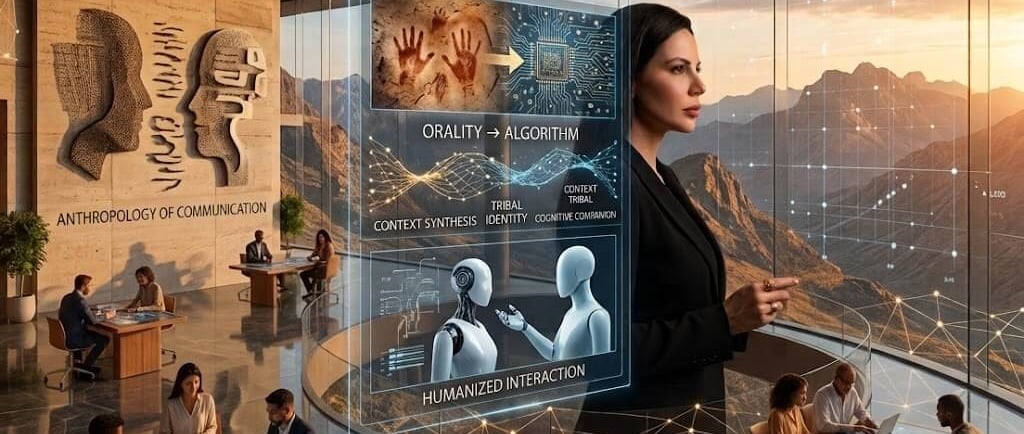
The history of humanity is not merely the history of our material tools, from stone hand axes to quantum supercomputers. It is, fundamentally, the story of our ability to exteriorize thought, encode experience, and negotiate meaning through language. The human species is, above all, a linguistic species. When we observe the contemporary technological ecosystem — dominated by social media, generative artificial intelligence, real-time data, and conversational interfaces — we tend to analyze the phenomenon through the lens of engineering, economics, or computer science. However, this perspective, while useful, misses the core element of the process: technology does not transform human discourse out of thin air; it is shaped, strained, and constantly reconfigured by the deep structures of our anthropological and communicative heritage.
The anthropology of digital communication emerges as an essential discipline to understand this dynamic. Its object of study is not the device itself, but the metamorphoses of the communicative act when mediated by integrated circuits and algorithms. Modern technological consumption — how we choose platforms, adopt software-as-a-service (SaaS) tools, interact with brands, and delegate decisions to artificial intelligence agents — is not the result of mere rational calculation or surface-level marketing manipulation. It is the visible symptom of profound transformations in the structure of discourse, the perception of time, the construction of identity, and forms of human sociability.
By analyzing the evolution of discourse — from the primary orality of non-literate societies to today's algorithmic hyper-textuality — we discover that new patterns of technological consumption respond to the ancestral needs of the social primate. The desire for immediacy, the search for tribal belonging through specific vocabularies, the preference for synthesis over wordiness, and the demand for humanized interactions with machines are not passing fads. They are reconfigurations of our cognitive and communicative structures. This article proposes an analytical journey through the anthropological layers underpinning modern digital language, demonstrating how the evolution of human discourse is the true engine behind new 21st-century consumption and market patterns.
1. From Primary Orality to Algorithmic Hyper-Textuality: A Genealogy of Language
To understand the contemporary digital consumer, one must perform an archaeological excavation into the development of human communication. Media theorist Walter Ong clearly distinguished primary orality — belonging to the culture of peoples with no knowledge of writing — from secondary orality, which represents the verbal culture sustained by radio, television, and electronic media. Today, we live in the era of tertiary orality, or algorithmic orality: a culture in which digital writing retrieves dynamic, fluid, and community-driven traits of ancestral orality, yet encapsulated in hypertextual structures and processed by artificial intelligence.
1.1 The Return of Tribal Agility in Digital Writing
In primary oral societies, knowledge relied on memory, rhythm, repetition, and physical presence. Gutenberg's invention of the movable type printing press in the 15th century triggered a cognitive revolution: discourse became linear, sequential, silent, and individualized. The printed book shaped the modern mind, analytical thought, and the bureaucracy of industrial organizations. Corporate communication and 20th-century market logic inherited this model: long reports, formal memos, rigid hierarchies, and one-way messages.
However, the digital environment broke the hegemony of Gutenberg's linearity. Writing on instant messaging platforms, social networks, and collaborative work interfaces does not operate like printed text. It is ephemeral, fragmented, conversational, and highly contextual. A modern corporate email or a team chat message is far closer to a spoken dialogue than an academic essay. We have returned, on a higher technological level, to the dynamics of orality through the constant search for rhythm and brevity, the use of paralinguistic elements such as emojis, memes, and GIFs to substitute for tone of voice and facial expression, and the expectation of immediate responses typical of face-to-face conversation.
1.2 Hypertext and the Fragmentation of Attention
The evolution from physical to digital mediums transformed the very architecture of thought. Linear text demands deep and continuous attention; hypertext, on the other hand, invites transversal navigation, jumping constantly between nodes of information. Contemporary human discourse adapted to this architecture. We no longer read the way our grandparents did: we scan, filter, and process information in non-linear matrices.
This structural shift profoundly alters technological consumption. Software platforms and enterprise solutions that demand a linear reading and navigation effort face immediate rejection. The modern user demands that technology reflect their new cognitive structure: fluid, networked, and visually synthetic. Human discourse has evolved to prioritize semantic density — the ability to convey maximum meaning with minimal syntactic noise — and the winning tech products on the market are precisely those that translate this evolution into their interfaces and language.
2. The Three Anthropological Pillars of Digital Discourse
The transformation of technological communication does not happen in a vacuum. It is driven by three fundamental anthropological vectors that redefined the relationship between the individual, language, and technology consumption: time-space compression, retribalization through idiolect, and the humanization of the machine interface.
2.1 Time-Space Compression: The Cult of Immediacy
Geographer and social theorist David Harvey coined the term time-space compression to describe how the economic and technological processes of late modernity shorten distances and accelerate the pace of life. From the anthropological perspective of discourse, this compression altered the temporal nature of language itself.
In traditional human communication, there was an intrinsic time gap between the emission, transmission, and reception of a message — such as the time it took to send a letter, wait for a meeting, or publish a newspaper. Digital technology eliminated this gap. Contemporary discourse operates under the sign of permanent synchrony.
This discursive immediacy creates a new consumption demand in which communication latency becomes the greatest point of friction in the user experience. Delayed responses in customer support channels or slow software interfaces are no longer seen merely as technical inefficiency, but as a discursive failure and an ethical disrespect. Consumers demand that technology speak at the speed they think and type. Real-time interaction ceased to be a technical feature and became an anthropological expectation.
2.2 Retribalization Through Idiolect: Identity and Belonging
French sociologist Michel Maffesoli anticipated the rise of neotribalism: the decline of abstract modern individualism in favor of micro-communities united by shared emotions, lifestyles, and, above all, language.
In the digital environment, human discourse has re-tribalized. Every virtual community, niche subculture, or corporate sector develops its own idioleto — a specific set of slang, acronyms, visual references, technical terms, and implicit codes. Mastering this idiolect serves as the primary marker of belonging and authority within the tribe.
How does this anthropological dynamic impact tech consumption? Brands and products using generic, homogenized language lose appeal, as modern consumers seek technologies that speak their native tongue. In the B2B market, for instance, a software solution for the financial sector must adopt the exact verbal aesthetic of that industry, while a tool for content creators must sound authentic to influencer culture. Choosing a technology has become an act of declaring tribal identity, where buying a specific device or adopting a platform communicates to the world which discursive group one belongs to.
2.3 Interface Humanization: The Desire for Dialogue with the Inanimate
Since prehistoric times, humanity has projected human characteristics onto nature, objects, and animals — an anthropological phenomenon known as anthropomorphism. In the digital communication era, this impulse found its most fertile ground: human-computer interaction.
As computers shifted from mere calculators operated by rigid command lines to processing natural language through artificial intelligence, human discourse demanded a radical shift in interfaces. We no longer want to navigate complex menus or fill out static forms; we want to converse.
The evolution of discourse forced the rise of conversational commerce and voice/text interfaces. Contemporary users prefer asking an artificial intelligence to "summarize this report and send it to the team" over manually opening, reading, formatting, and attaching a document. We demand that the machine take responsibility for translating our linguistic intent into operational action. Technology incapable of sustaining fluid, contextualized dialogue is perceived as archaic.
3. Redefining Technological Consumption Patterns
The anthropological evolution of discourse does not just affect how we interact with screens; it fundamentally reconfigures the economics of technology consumption across three critical dimensions: attention, trust, and perceived utility.
3.1 The Attention Economy and the War for Synthesis
In an environment of information overabundance, human attention has become the scarcest and most contested resource on the planet. Human discourse adapted to this scenario by developing a strong preference for high-value synthesis.
The modern consumer has developed a sophisticated filter against wordiness and fluff. Corporate speak filled with empty adjectives, exaggerated claims, and lengthy texts with no immediate utility are discarded in fractions of a second. This has redefined how technology is marketed and designed.
We see the growth of product-led growth (PLG) adoption models, where consumers do not want to read 50-page manuals or sit through multiple sales meetings to grasp a software's value. They demand to experience the tool immediately, guided by simple, intuitive, and direct interface language. Clarity and verbal minimalism have become the single greatest differentiation asset for high-value tech products, as linguistic precision conveys that the underlying engineering is equally refined and robust.
3.2 Trust in the Era of Disinformation and Generative AI
As generative AI makes the creation of text, image, and audio cheap and infinite, the digital ecosystem has been flooded with low-quality synthetic content. This phenomenon triggered an anthropological crisis in human communication: the breakdown of trust in the written and visual word.
Faced with the inflation of automated and generic discourse, tech consumption patterns shifted toward a demand for authenticity and proof of origin. Contemporary consumers have developed a sharp sensitivity to detecting when discourse is purely robotic and devoid of real intent. This creates a major paradox for technology companies: while automation is essential for scaling support and operations, uncurated, ungoverned automation destroys brand trust.
The new winners in the tech market are organizations using artificial intelligence not to replace human discourse, but to amplify it. Consumer trust now relies on transparency regarding technology usage and the guarantee that behind the automated interface lies an ethical, rigorous commitment to factual truth.
3.3 The Shift from "Tool Software" to "Companion Software"
Historically, software was viewed as a passive tool: a digital hammer awaiting user instructions. The evolution of human discourse, coupled with advances in language models, irreversibly altered this relationship.
Today, we consume technology not just as a utility, but as a discursive and cognitive partner. We expect operating systems, productivity apps, and enterprise platforms to understand task context, anticipate communication needs, and assist us in drafting, analyzing, translating, and synthesizing ideas.
This paradigm shift radically transforms the technology industry's business model. A software's perceived value no longer lies in the sheer number of buttons or features on its toolbar, but in the quality of the linguistic interaction it establishes with the user. Consumers willingly migrate from traditional tools to an intelligent ecosystem acting as an extension of their own thought and discourse.
4. Language as User Experience Architecture (Verbal UX)
If language shapes tech consumption, discourse engineering must be treated as a core component of product development and business strategy. This is where the anthropology of communication meets the practice of Verbal UX (User Experience Verbal) and information architecture.
For years, user experience focused almost exclusively on visual aspects: colors, layouts, buttons, typography, and screen hierarchy. However, in a world dominated by artificial intelligence and conversational interfaces, the verbal dimension has become the central pillar of experience.
4.1 Microcopy and Consent Design
Every word displayed on a technological interface — from button labels to error messages and purchase confirmation terms — carries decisive weight in the consumer journey.
Microcopy is the translation of discursive synthesis applied to technology. Where traditional error messages used machine-oriented language, like rigid technical codes that induced anxiety and friction, humanized and action-oriented microcopy focuses on the user, communicating warmly while guiding them toward a solution. Interface language has evolved from a technical era centered on system functions and jargon to an anthropological era focused on natural language, context, and real user goals.
Furthermore, the anthropology of discourse teaches us that user consent, crucial in the context of data protection laws, cannot be gained through linguistic traps or indecipherable legal jargon. Ethical tech consumption requires consent design to use plain language, ensuring users clearly understand what they are granting, why they are granting it, and how they can revoke that decision.
4.2 Building Algorithmic Models with Anthropological Sensitivity
Creating language models and virtual agents is not a job solely for software engineers and data scientists. Without input from language scientists and anthropologists, automated systems fail to capture the nuances of real human discourse, such as irony and sarcasm — highly cultural elements that frustrate simplistic virtual assistants; regional and social variations; and contextual empathy, the discursive skill of recognizing user frustration or stress and adapting communication tone instantly.
Globally leading technologies are those whose algorithms were calibrated to recognize and respect the complexities of real human discourse, avoiding the feeling of interacting with an unfeeling automated form.
5. Ethical Challenges and the Future of Technological Communication
The evolution of human discourse mediated by technology brings along a set of ethical dilemmas that companies, tech leaders, and society must confront. The ease with which discourse can be manipulated, automated, and amplified in the digital realm creates unprecedented risks for social cohesion and individual autonomy.
5.1 The Colonization of Discourse by Algorithmic Language
As we spend more time interacting with digital platforms that suggest automatic replies, complete our sentences with predictive text, and rewrite our emails with artificial intelligence, the risk of human discourse homogenization emerges.
If everyone relies on the same language models to write, think, and communicate, we risk impoverishing linguistic diversity and the richness of cultural identities. Anthropology warns against an algorithmic colonization of language, where human discourse loses its spontaneity, creative imperfections, and regional nuances in favor of standardized, globally sterile corporate prose.
Future-proof companies will need to champion discursive uniqueness. True competitive differentiation will not come from generating generic text at scale, but from cultivating an authentic, human, and unmistakable voice.
5.2 Algorithmic Addiction and Affective Manipulation
Deepening our anthropological lens, we see that discourse on social media and digital platforms has been optimized to exploit innate human emotional triggers: fear of missing out (FOMO), moral outrage, social validation, and the pursuit of instant gratification.
Tech consumption patterns driven by "engagement at any cost" use language as a tool for emotional manipulation. This has fueled public debate polarization, mental health crises, and the degradation of the public communicative sphere.
The future of tech consumption requires a turn toward what we might call human, sustainable technology. Consumers are beginning to reject platforms that exhaust their mental health and drain their time through toxic discursive dynamics. A growing market space exists for tech solutions promoting constructive discourse, focused on digital mindfulness, respect for user time, and the cultivation of real, meaningful connections.
Conclusion: The Human Imperative in the Future of Technology
The trajectory of the anthropology of digital communication reveals an unequivocal truth: technology is the medium, but human discourse is the raw material. No matter how advanced processors become, how vast datasets grow, or how sophisticated artificial intelligence models evolve, technology's success will continue to hinge on its ability to resonate with humanity's communicative nature.
New technological consumption patterns — driven by immediacy, the pursuit of authenticity, neotribalism, and the desire for humanized conversational interactions — are not market anomalies. They are the living manifestation of our evolving discourse adapting to a new digital habitat.
Companies, leaders, and professionals wishing to thrive in this new era cannot view communication as a mere marketing add-on or a superficial interface layer. Communication must be understood in its anthropological depth: as the fundamental structure that constructs realities, builds trust, and defines the value of the technologies we create.
In a world saturated with talking machines, the ultimate competitive advantage will remain our capacity to comprehend, with rigor, empathy, and depth, the true essence of human language. Technology passes, code becomes obsolete, but the human search for meaning through the word remains unshakable.


